
| How do you know if a packaging test is actually reducing risk or just satisfying a requirement? A test reduces risk when it reflects how your product is actually shipped — the specific distribution mode, cumulative handling events, and environmental exposure it will really encounter. A test just checks a box when it’s chosen because it was requested, not because it matches real conditions. The tell: packages that pass the test and still fail in the field almost always failed the second test, not the first. |
Choosing which packaging tests reduce risk is one of the most consequential decisions a packaging engineer or quality team makes before commercial release — and it’s rarely a testing failure when it goes wrong. Packaging failures rarely come from a lack of testing. They come from choosing the wrong test for the real distribution environment.
Many packages pass a standard test and still fail in the field. When that happens, the test validated compliance, not risk — and the cost of that gap doesn’t show up until after commercial release, when it’s a damage claim or a recall instead of a line item on a test invoice.
Why Some Packaging Tests Don’t Reduce Risk
Most packaging tests are designed to be repeatable and standardized. That’s necessary for compliance, but it doesn’t automatically translate to real-world protection.
Risk is driven by how your product is actually shipped — parcel versus LTL, unitized versus palletized, one distribution cycle versus multiple. If the test doesn’t reflect those conditions, it may only confirm that a minimum requirement was met, at the cost of missing the failure mode that’s actually going to happen.
Which Tests Reduce Risk in Parcel Distribution
For parcel shipments, the decision comes down to selecting the right ISTA procedure — and the gap between the wrong one and the right one is bigger than it looks.
- ISTA 1A is a basic integrity test. It identifies obvious weaknesses but doesn’t simulate real carrier hazards — running this on a high-value or fragile product gives you a passing result that tells you almost nothing about your actual risk.
- ISTA 2A adds conditioning and sequence changes that better represent parcel handling.
- ISTA 3A simulates small parcel delivery with defined drop heights, vibration profiles, and compression forces.
If you’re shipping through parcel networks and seeing damage, gh Testing generally finds ISTA 3A provides the highest risk reduction, because it models cumulative handling events rather than isolated impacts — the difference between “did it survive one drop” and “did it survive the actual trip.”
ASTM Tests That Reduce Risk by Isolating Failure Modes
ASTM methods are most effective when you already know what you’re trying to stress — used blind, they produce data that’s technically valid but operationally incomplete.
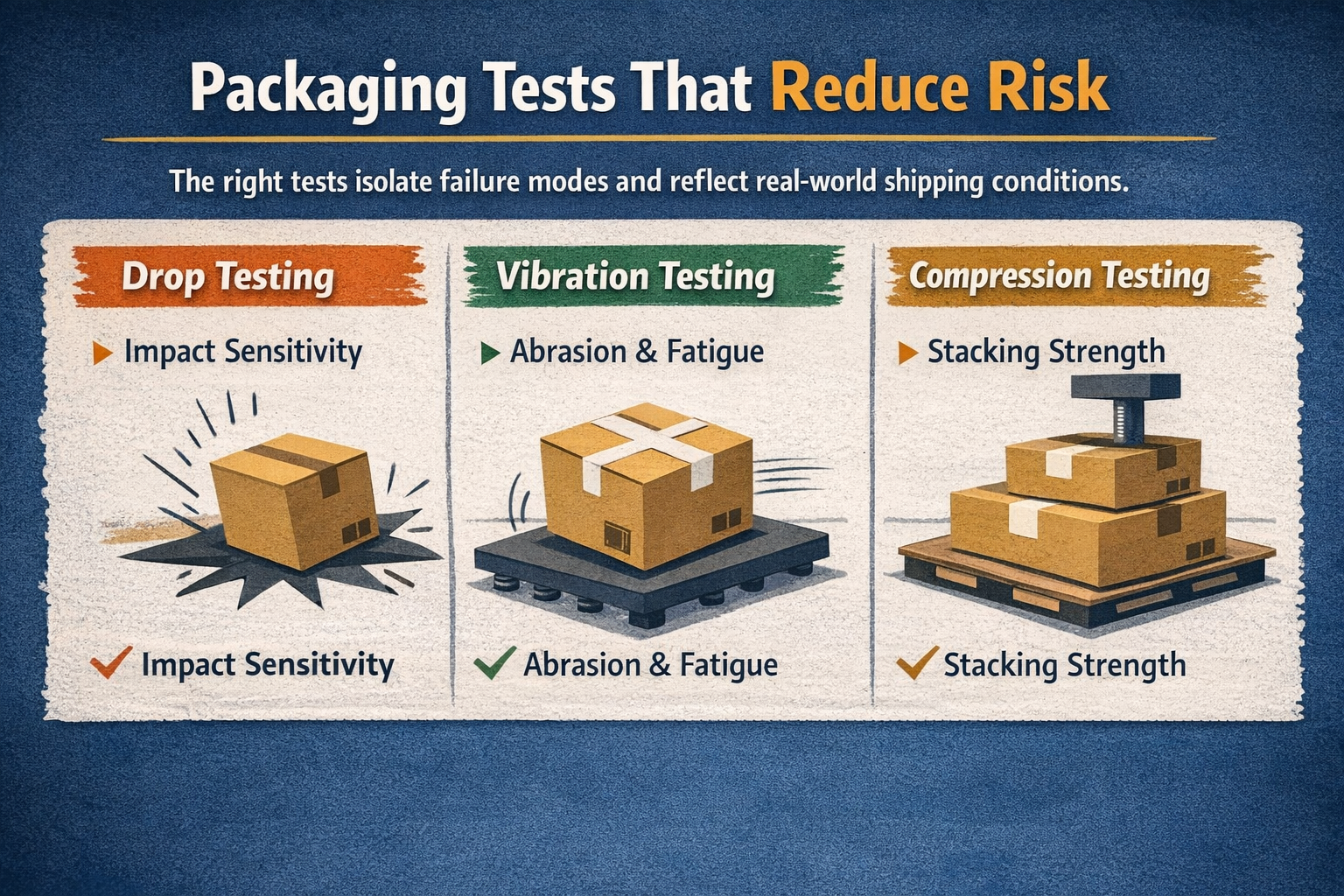
- ASTM drop testing isolates impact sensitivity
- ASTM vibration testing evaluates loosening, abrasion, or fatigue
- ASTM compression testing assesses stacking and top-load risk
Skipping vibration testing specifically is a common gap: if damage is occurring without visible drop events, vibration fatigue is the usual suspect, and a drop-only test program will never catch it.
Environmental Conditioning Is Often the Missing Link
Environmental exposure is one of the most underestimated sources of packaging failure — and one of the most commonly skipped tests, since it’s the one most likely to get cut under schedule pressure.
Heat, cold, and humidity can weaken corrugate, soften adhesives, or change material behavior before mechanical testing even begins. Conditioning protocols aligned with ASTM environmental standards are often what turn a passing package into a failing one — the package that looked fine at 72°F and 50% RH is not the same package that shipped through a summer trailer.
If your product ships through uncontrolled environments or sits in transit for extended periods, conditioning isn’t optional. It’s central to whether the rest of your test data means anything.
If you’re not sure whether your current test protocol reflects real risk or just checks a compliance box, that’s exactly what a Test Protocol Risk Review answers. Contact gh Testing — tell us how your product actually ships, and we’ll tell you where your current test plan has a gap.
Tests That Check a Box But Don’t Lower Risk
Some tests get run because they’re requested, not because they reflect reality:
- Using ISTA 1A for high-value or fragile products
- Skipping vibration testing when damage occurs without visible drops
- Ignoring environmental conditioning for products sensitive to moisture or heat
These may satisfy a documentation requirement, but they do little to prevent damage, returns, or field failures — and the cost shows up later, in a return rate or a chargeback, not in the test report itself.
The Decision Rule
Before finalizing a test protocol, ask one question: does this test reflect the specific way my product ships — mode, cumulative handling, and environment — or does it just meet a minimum standard? If you can’t answer that with confidence, the test plan is compliance-driven, not risk-driven, and it’s worth a review before commercial release, not after a field failure.
Frequently Asked Questions
How do I know if my current test protocol is risk-driven or just compliance-driven?
Check whether the test was selected based on your actual distribution profile — parcel vs. LTL, single vs. multiple cycles, real environmental exposure — or based on what’s minimally required. If nobody can point to why a specific ISTA or ASTM method was chosen for your specific shipping conditions, it’s likely compliance-driven.
Is ISTA 1A ever the wrong choice, even though it’s a valid standard?
Yes, for the wrong product. ISTA 1A is a legitimate baseline for low-risk, low-value parcel shipments, but it under-tests high-value, fragile, or complex products — a passing ISTA 1A result on the wrong product type creates false confidence rather than real risk reduction.
Can environmental conditioning be skipped if my product passed mechanical testing without it?
Not reliably. Heat, cold, and humidity change material properties — corrugate strength, adhesive bond, seal integrity — independent of mechanical stress. A product that passes drop and compression testing at ambient conditions can still fail once heat or humidity is introduced, because the conditioning step tests a different failure mode entirely.
Practical Takeaway
The tests that reduce risk are the ones that reflect how your product is actually handled, stored, and transported. Compliance alone doesn’t protect products. Alignment does.
If you want help selecting the correct test based on your real shipping conditions, gh Testing’s short risk review often prevents months of rework after launch. Contact us or call 513-870-0080.