
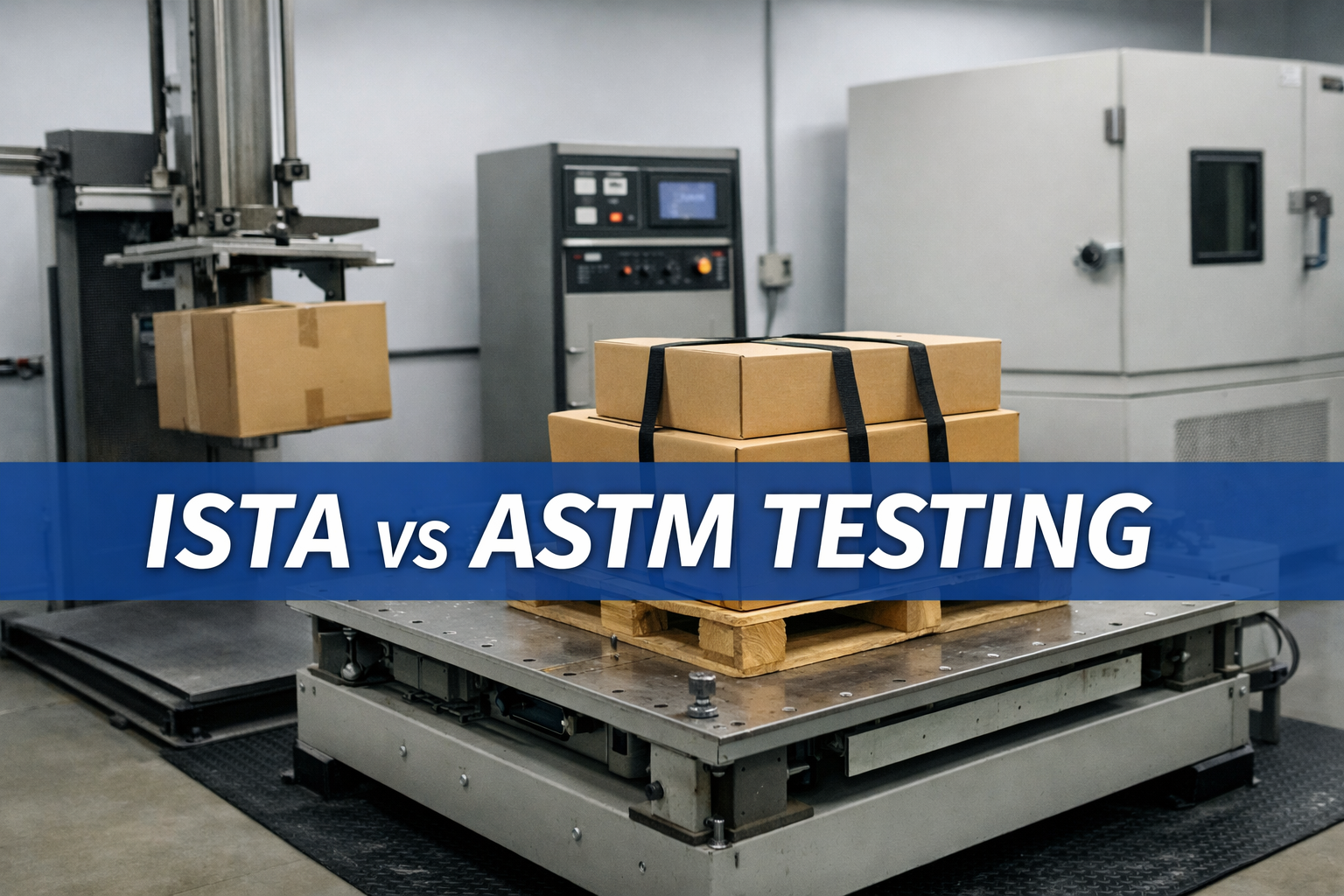
Packaging teams often assume that passing a standard test means their product is protected. The reality is more complicated. ISTA vs ASTM testing is not a matter of which standard is better, but whether either standard actually reflects the real risks your package will face in distribution.
Both ISTA and ASTM tests are useful tools. They are not guarantees of performance. Understanding where they fall short is critical before commercial release.
Why ISTA vs ASTM testing is often misunderstood
ISTA and ASTM serve different purposes. ISTA procedures are designed to simulate common distribution environments using defined sequences. ASTM methods focus on isolating specific mechanical or environmental stresses.
Problems arise when teams treat either as a complete validation strategy rather than a starting point.
Common misunderstandings include:
- Assuming an ISTA pass equals real world survivability
- Running ASTM tests without understanding how stresses combine in transit
- Using compliance as a substitute for performance evaluation
ISTA vs ASTM testing decisions should be driven by how your product actually moves, not by what is easiest to specify.
Where ISTA testing can leave gaps in packaging validation
ISTA procedures such as 1A, 3A, and 6 Amazon are widely used because they are structured and repeatable. They are excellent for baseline screening and compliance driven programs.
However, ISTA tests are generalized by design. They do not always reflect:
- Product specific fragility
- Nonstandard pallet patterns or load heights
- Seasonal or regional environmental exposure
- Unique handling events like manual sort or mixed mode transport
For example, ISTA 3A assumes a certain distribution profile that may not match heavier products, cold chain shipments, or bulk B2B freight. Passing the test does not mean failure modes have been fully explored.
Where ASTM Methods Can Fall Short
ASTM methods such as drop, vibration, compression, and environmental conditioning allow engineers to isolate individual stresses. This makes them powerful diagnostic tools.
The limitation is that real distribution is not isolated.
In the field, packages experience:
- Repeated drops after vibration
- Compression under fluctuating humidity
- Cold exposure followed by handling impacts
Running ASTM tests independently without understanding how stresses stack can underestimate risk. ASTM methods are most effective when combined into sequences that reflect real handling and transport conditions.
When Custom Testing Becomes Necessary
Custom testing fills the gap between standards and reality. It is often the only way to understand true performance limits.
Custom sequences are especially important when:
- Products ship in cold weather or controlled temperature lanes
- Packaging uses new materials or cost reduced designs
- Loads are tall, heavy, or nonuniform
- Failure risk is high due to returns, damage claims, or regulatory exposure
At gh testing, custom testing often blends ISTA procedures, ASTM methods, and environmental conditioning such as heat, cold, and humidity into a single program. The goal is not to replace standards, but to pressure test beyond them.
Practical Takeaway for Packaging Teams
ISTA vs ASTM testing should not be an either or decision. Both standards are tools, not solutions.
A strong validation strategy asks:
- What does my product actually experience in distribution?
- Which tests reveal failure modes instead of just confirming compliance?
- Where do I need custom sequences to close risk gaps?
Testing should answer questions, not just satisfy a checklist.
Next Step
If you are unsure whether your current test plan truly reflects your distribution risks, request a packaging risk review or ask which test is right for your product.
The right testing approach helps catch problems before commercial release, when fixes are still manageable and cost effective.