
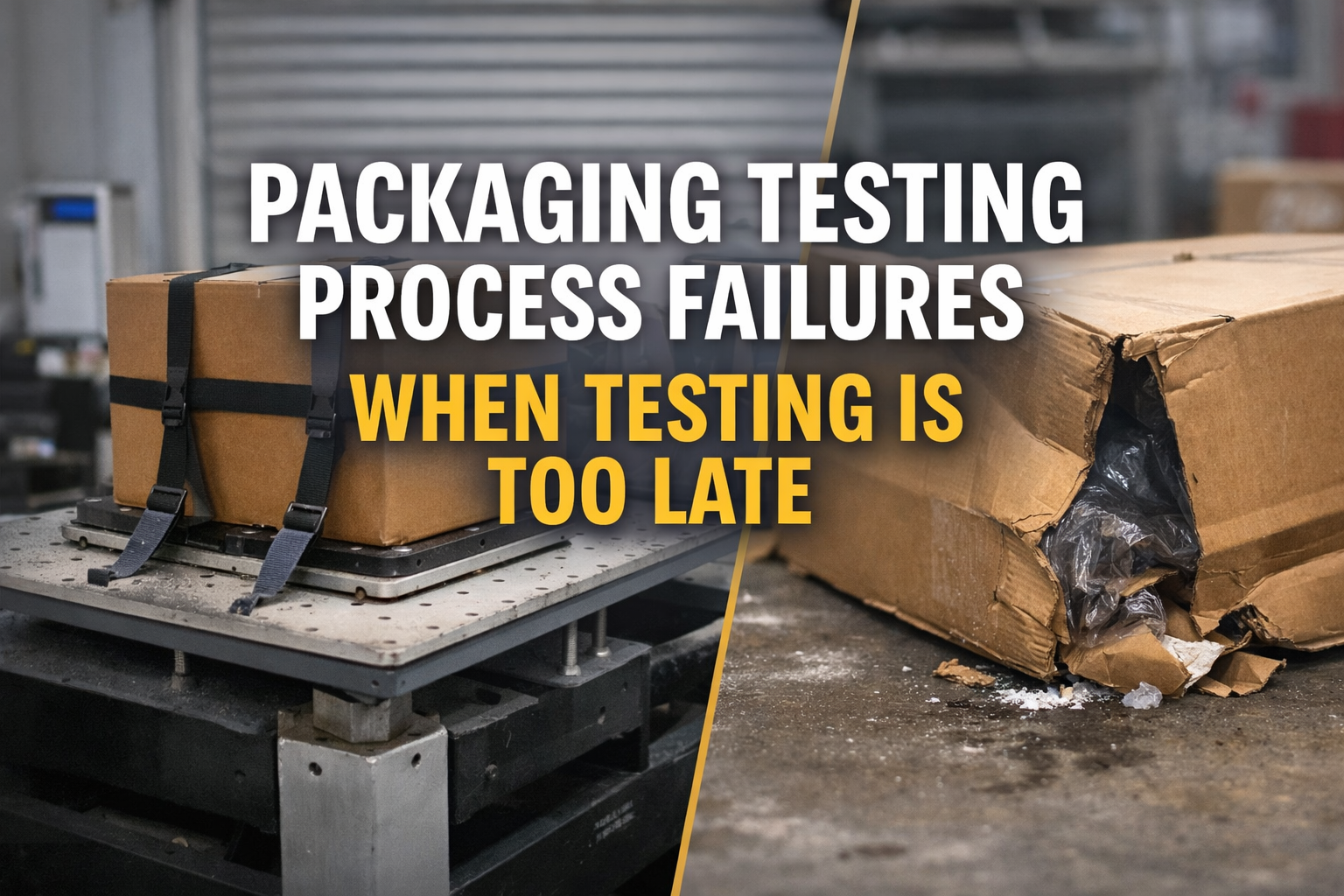
| Why does packaging testing sometimes fail to prevent problems, even when it’s performed correctly? Because of timing, not technique. Testing introduced after design freeze — once materials, cushioning, and pack configuration are already locked — can only confirm risk, not correct it. By that point, a failed test triggers reactive retesting instead of an actual design fix, because the option to change the design cheaply is already gone. |
Packaging testing process failures rarely happen because tests are performed incorrectly. They happen because testing is introduced too late — after packaging design decisions have already been finalized. When testing is treated as a final checkpoint instead of part of development, it confirms risk instead of reducing it.
The cost of that timing gap isn’t abstract. A design change made before tooling is committed costs a redesign cycle. The same change made after production has started costs a redesign cycle, a retest cycle, and whatever inventory or schedule commitment already exists around the current configuration.
How Process Failures Start at Design Freeze
Many packaging testing process failures originate during late-stage design freeze. Materials, cushioning systems, and pack configurations are often locked to meet cost or schedule targets before any meaningful physical testing begins. At that point, test results may identify weaknesses but offer limited options for correction.
Testing performed after design freeze tends to expose problems that are expensive or disruptive to fix — not because the test found something new, but because the window to act cheaply on what it found already closed.
Late Distribution Testing Limits Corrective Action
Late-stage testing often focuses on full distribution simulation. Procedures such as ISTA 3A or ISTA 6-Amazon effectively identify parcel and e-commerce risks — but when run at the end of development, failures trigger reactive retesting rather than informed design changes, because there’s no longer a decision left to inform.
ASTM drop, vibration, or compression testing at this stage may confirm damage modes without providing a practical path to improvement — you learn what broke, but the design is already locked against fixing it easily.
Early Testing Prevents These Failures
Introducing testing earlier in development changes how results actually get used. Basic ASTM vibration, drop, and compression testing during early design phases helps identify sensitivity before materials and configurations are finalized. Environmental conditioning for heat, cold, or humidity can further reveal performance shifts before scale-up — while there’s still a design decision on the table to respond to.
gh Testing sees this pattern consistently: teams that test early treat a finding as an input to design. Teams that test late treat the same finding as a crisis to manage.
If your team has been catching packaging problems at the final distribution test — after tooling and materials are already committed — that’s a timing gap, not a testing gap. Contact gh Testing for a Test Timing Review — tell us where testing currently sits in your development process, and we’ll tell you what moving it upstream would actually change.
Retesting Is Usually a Symptom, Not a Solution
Repeated rounds of testing are usually a sign of an upstream gap, not a testing problem. When teams rely on late-stage distribution testing alone, failures lead to incremental changes followed by additional ISTA or ASTM testing — extending timelines without meaningfully increasing confidence, because each retest is still discovering problems a design decision could have prevented.
Packaging testing process failures frequently reflect the need to move risk assessment earlier, not add more testing at the end.
The Decision Rule
Before your next test cycle, ask: is this test confirming a decision that’s already been made, or is it still early enough to inform one? If materials, tooling, and configuration are already locked, the test can only tell you what to fix reactively. If they’re not locked yet, the same test tells you what to fix while it’s still cheap.
Frequently Asked Questions
At what point in development is it too late to catch a packaging issue affordably?
Generally, once materials are sourced and tooling is committed. Before that point, a test finding changes a design decision. After it, the same finding requires a redesign, a retest, and often a delay to whatever production or launch schedule already exists around the locked configuration.
If our packaging keeps failing the same type of test repeatedly, does that mean the test is wrong?
Usually not — it typically means the underlying design issue was never actually corrected, just retested. Repeated failures on the same failure mode point to a process gap upstream (testing introduced too late to inform the design) rather than a flawed test.
Can early-stage testing replace full distribution testing later in development?
No — they serve different purposes. Early testing (basic ASTM vibration, drop, compression, and environmental conditioning) identifies sensitivity while the design can still change. Full distribution testing (ISTA sequences) later confirms the finalized design holds up. Skipping early testing doesn’t just risk failure — it turns the later, more expensive test into the first real check instead of the final confirmation.
Move Testing Upstream
Packaging testing is most effective when it informs decisions, not just validates outcomes. Early-stage vibration, drop, and compression testing combined with targeted environmental conditioning lets teams address risk while design changes are still manageable. Full distribution testing then becomes confirmation rather than discovery.
With testing teams supporting clients from both our Ohio and Phoenix labs, gh Testing works with packaging engineers across regions to align test timing with real development decisions. Request a packaging risk review to determine how moving testing upstream may reduce risk before commercial release.