
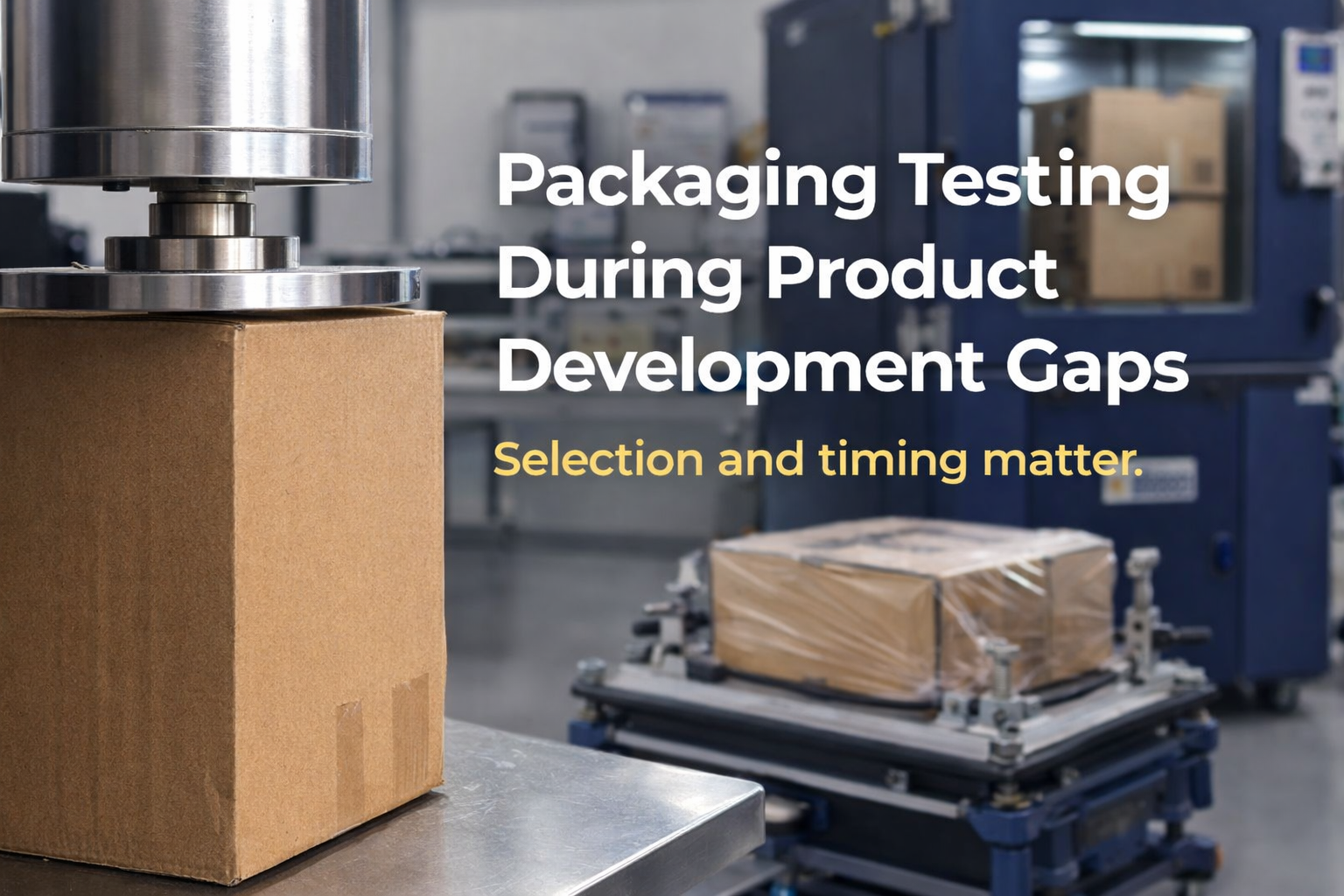
Packaging testing during product development is often treated as a final validation step instead of an engineering input. When testing is delayed, early material and structural assumptions go unchallenged. The result is late-stage failures that could have been identified months earlier.
Why Packaging Testing During Product Development Gets Delayed
In many CPG, medical, and automotive programs, packaging testing during product development begins after design freeze. Material selection, board grade, cushioning design, and sealing methods are already locked in.
At that point, ASTM compression or ISTA 3A distribution testing becomes a confirmation exercise rather than a diagnostic tool. If vibration fatigue or humidity sensitivity appears, redesign is expensive and disruptive.
Early-stage screening reduces that risk.
Common Gaps in Packaging Testing During Product Development
The gaps are rarely dramatic. They are incremental oversights.
• No early ASTM compression screening on prototype corrugated
• No short-duration ASTM D4728 vibration exposure before tooling approval
• Environmental conditioning deferred until final validation
• ISTA 1A used without understanding distribution intensity
Compression strength measured at standard lab conditions does not reflect elevated humidity storage. Vibration performed only at final validation can reveal fatigue after tooling is complete.
Environmental conditioning using heat, cold, and humidity should inform material selection, not just support final reports.
Find our testing capabilities here.
ASTM vs ISTA: Different Objectives in Development
During development, it is important to understand what each method contributes.
ASTM methods such as D4169, D5276 (drop), and D4728 (vibration) provide structured, hazard-based simulation.
ISTA 1A and 3A provide performance-oriented distribution testing.
ISTA 6-Amazon focuses on e-commerce parcel environments.
Standards are published and maintained by organizations such as ISTA.
Using ISTA 3A too early can obscure material-level weaknesses that ASTM screening would identify. Using ASTM compression alone may ignore real parcel distribution dynamics.
Early testing should expose variables, not just replicate final distribution.
Find our testing capabilities here.
Environmental Conditioning in Packaging Testing During Product Development
Environmental conditioning is often postponed until formal validation. This creates blind spots.
Corrugated stiffness declines at elevated relative humidity. Polymers may embrittle at low temperatures. Adhesive bonds respond differently after thermal exposure.
Running early environmental chamber screening allows teams to see how compression and vibration results shift after conditioning.
Find our testing capabilities here.
Development Checklist: Compare Your Plan to Real Failure Modes
Use this checklist during packaging testing during product development:
• Have we performed compression testing on prototype packaging?
• Have we run short-duration vibration before final tooling?
• Have we evaluated packaging after humidity conditioning?
• Have we screened for internal product movement under vibration?
• Have we aligned ISTA or ASTM test selection with actual distribution channels?
If the answer to multiple questions is no, the risk window increases as the project advances.
Practical Takeaway
Packaging failures rarely originate in final validation. They originate in assumptions made during development.
Running targeted ASTM material tests, early vibration screening, and environmental conditioning reduces late-stage redesign and protects launch timelines.
If you are evaluating your current development plan, compare your test sequence to known failure modes before commercial release.
Get help selecting the correct test.
Summary
Packaging testing during product development should inform design decisions, not simply validate finished packaging. Early compression, vibration, and environmental screening reduce cumulative distribution risk and improve confidence before launch.