
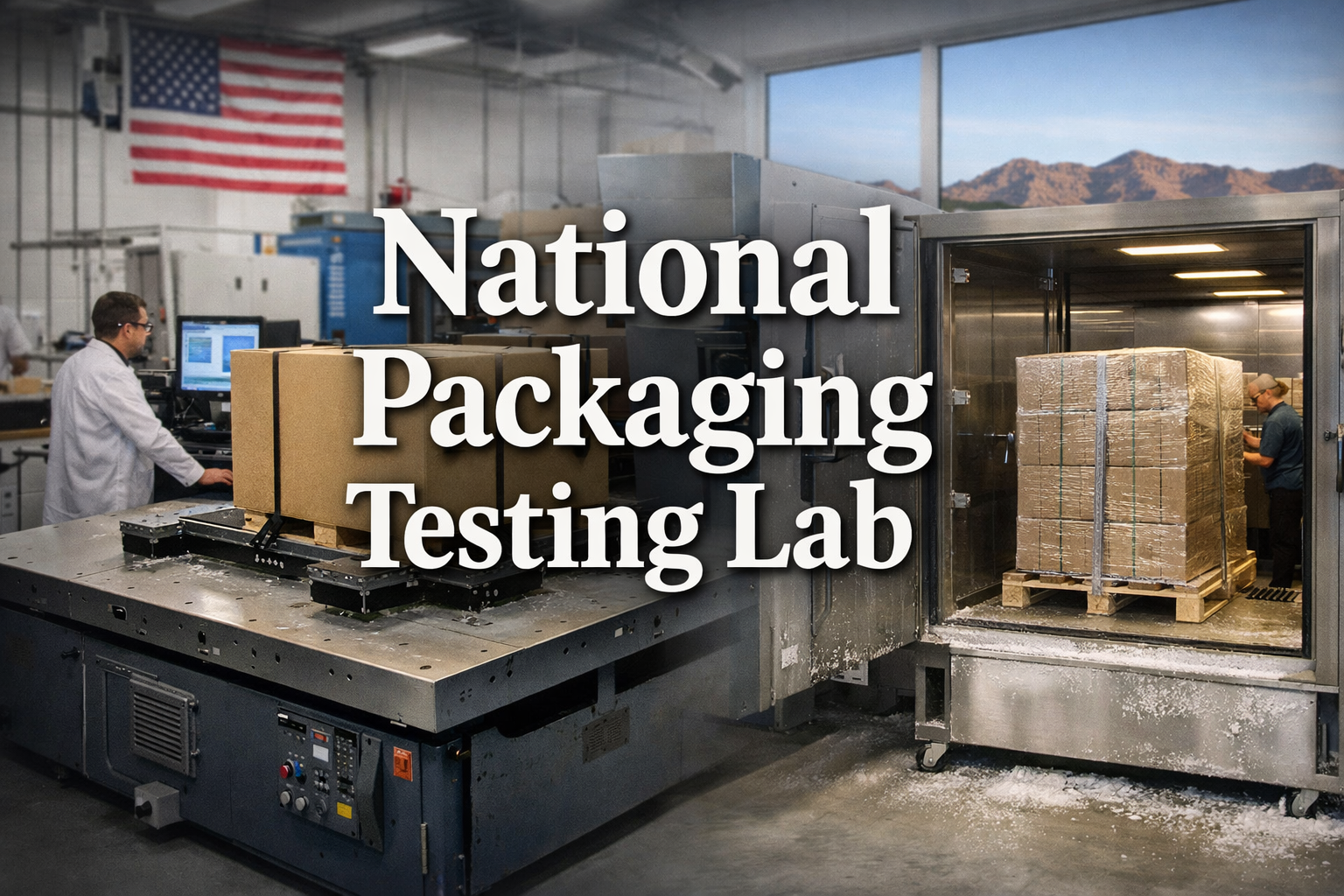
When validation schedules tighten, the issue is rarely the packaging design. More often, it is lab capacity. A national packaging testing lab prevents bottlenecks by distributing ISTA testing, ASTM procedures, and environmental conditioning across multiple facilities.
Launch delays often start in the queue.
Why a National Packaging Testing Lab Prevents Validation Bottlenecks
Single-location labs can only run so many sequences at once. During peak seasons, medical device launches, CPG resets, and industrial changeovers overlap.
If vibration tables and environmental chambers are booked, validation waits.
A national packaging testing lab avoids this by running programs in parallel. While one site completes ISTA vibration and drop, another can begin compression or conditioning.
Capacity becomes a schedule control tool.
Parallel ISTA Testing in a National Packaging Testing Lab
ISTA 1A, 3A, and 6-Amazon procedures require sequencing. ASTM D4169 distribution cycles include vibration, compression, and impact steps that cannot overlap in a single chamber.
When multiple facilities are available, programs move faster.
Parallel testing allows:
• Concurrent ISTA procedures
• Independent ASTM compression and vibration testing
• Simultaneous environmental conditioning
• Reduced queue stacking
You can review our testing capabilities here.
ASTM testing details are outlined here.
Reference standards are maintained by the International Safe Transit Association, ISTA.org.
Environmental Conditioning Is Often the Constraint
Environmental conditioning is one of the most common schedule bottlenecks.
Heat, cold, and humidity exposures often require 72 hours or more. Severe cold or tropical wet conditioning extends dwell time. If chambers are limited, projects queue quickly.
A multi-location testing structure distributes workload instead of stacking it.
Learn more about our environmental testing capabilities.
Ohio and Phoenix: Geographic and Climate Advantage
Location matters.
Our Ohio laboratory supports Midwest and East Coast manufacturers. Our Phoenix laboratory supports West Coast programs and offers a natural high-heat environment for thermal validation.
This structure reduces freight time and allows multi-site scheduling. Samples move closer to where they are produced. Testing begins sooner.
Geography supports capacity.
Vendor Selection Should Include Capacity Planning
Most validation delays are not technical errors. They are scheduling conflicts.
Engineering changes. Regulatory timing. Production shifts.
If your testing partner cannot flex capacity, validation becomes the bottleneck.
A national packaging testing lab distributes workload instead of stacking it.
If you are evaluating testing partners, consider how multi-location capacity may reduce validation delays.