
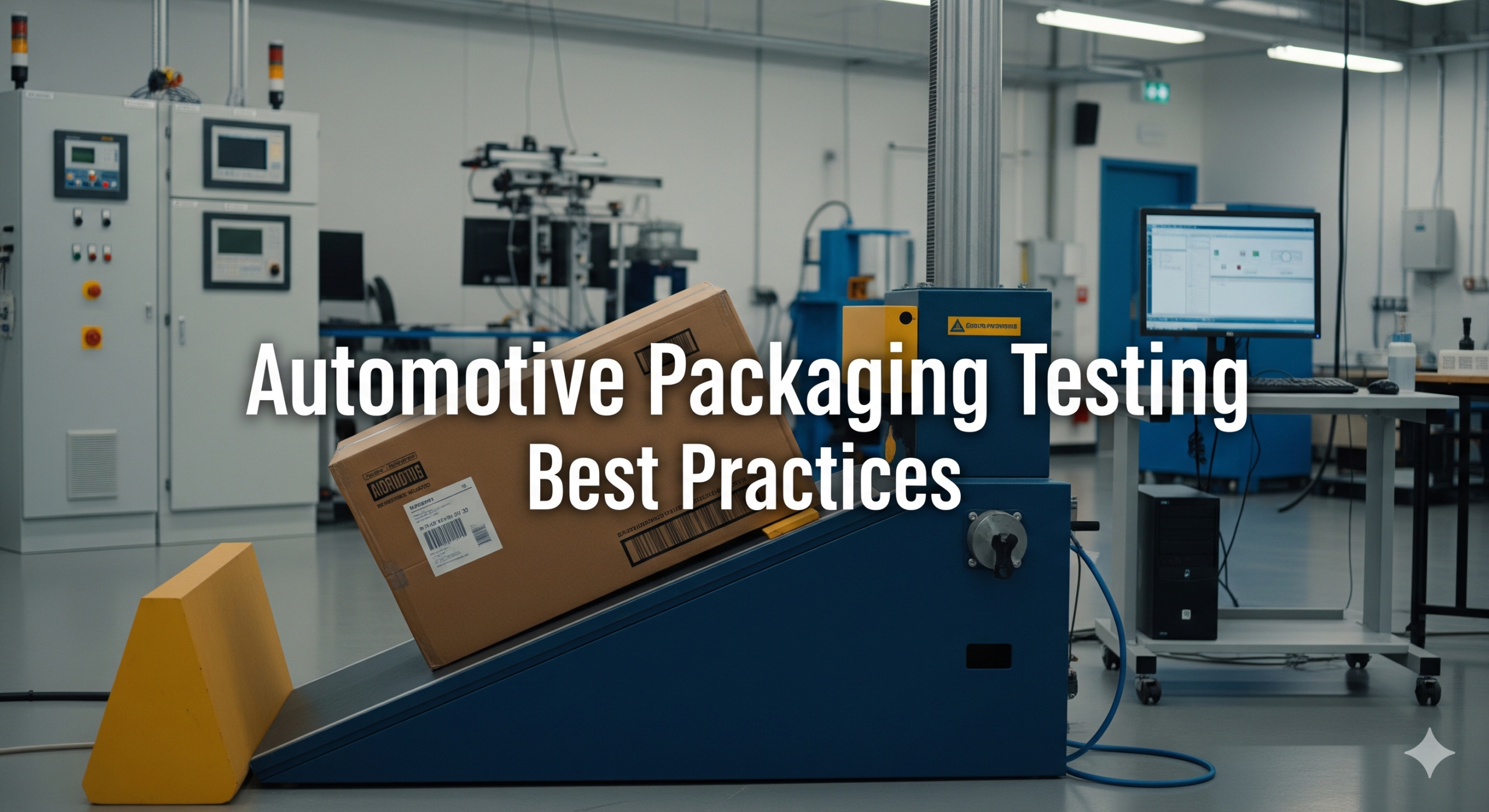
What are automotive packaging testing best practices?
Automotive packaging testing best practices include running ISTA 3A and ASTM D4169 sequences conditioned to real-world humidity and temperature profiles, documenting specific failure modes rather than pass/fail outcomes, extending vibration test duration to match actual distribution legs, and treating incline impact and compression as equal priorities alongside drop testing. These practices are developed in automotive supply chains where a packaging failure stops a production line — and they transfer directly to CPG, pharmaceutical, medical device, and industrial programs.
Automotive packaging engineers test to failure. That’s not a flaw in the methodology — it’s the entire point.
In most industries, a packaging test program exists to confirm that a design meets a defined threshold. Pass the sequence, approve the package, move on. In automotive, the goal is different: find exactly where and how failure occurs so the package can be redesigned before a single part reaches an assembly line. It’s a subtle but consequential shift in philosophy — and it produces a fundamentally different level of packaging reliability.
At gh Package and Product Testing, we run packaging test programs for automotive Tier 1 and Tier 2 suppliers, CPG manufacturers, medical device companies, and industrial distributors out of our ISO 17025 accredited labs in Middlefield, Ohio and Phoenix, Arizona. The discipline we see in automotive programs is worth examining closely because it applies directly to any industry where a packaging failure carries real cost.
Why Automotive Packaging Testing Sets the Standard
The automotive supply chain has almost no tolerance for variation. A Tier 1 supplier delivering brake components, sensors, or precision-machined housings to an OEM operates within a system that cannot absorb in-transit damage, contaminated parts, or inconsistent packaging performance. When a production line stops because of a packaging failure, the cost is immediate and quantifiable — and the test engineer whose name is on the report is the one who has to explain it.
That pressure produces rigorous protocols. Two standards define most automotive packaging test programs:
- ASTM D4169 — Performance Testing of Shipping Containers and Systems. A multi-hazard simulation sequence covering vibration, shock, compression, and atmospheric conditioning, structured around defined distribution cycles.
- ISTA 3A — General Simulation Performance Testing. Widely used for packaged products moving through complex supply chains. Simulates the cumulative stress of a full distribution environment including handling, transit vibration, and drop events.
What makes automotive programs distinct isn’t which standard is used — it’s how the standards are applied. Automotive engineers layer internal protocols on top of ISTA and ASTM requirements, push test parameters beyond minimums, and document failure modes in detail rather than recording pass/fail outcomes.
The Three Tests That Reveal the Most
Vibration Testing
Road and rail transit expose packaged automotive parts to sustained, resonant vibration that differs significantly from a single-event shock. ASTM D4169 and ISTA 3A both include vibration sequences, but automotive programs frequently extend duration and vary frequency profiles to simulate specific distribution legs — domestic over-the-road, international ocean freight, air with ground transfer.
What vibration testing surfaces: resonant frequency failure in packaging assemblies, fatigue failure in corrugated structures, and product migration that causes contact damage at the point of installation. For precision components with tight dimensional tolerances, that migration is one of the most common root causes of in-transit damage that only reveals itself when a part is being assembled.
Incline Impact Testing
Incline impact — ASTM D880 — simulates the sudden deceleration when a package strikes a dock plate, a conveyor stop, or another package during handling. It’s frequently underweighted in non-automotive programs. Automotive engineers have seen enough dock-strike failures on heavy components to treat it as a required test, not an optional one.
For heavy products or components with concentrated weight, this test frequently surfaces failure modes that vertical drop testing never finds — particularly in end-user packaging for castings, subassemblies, and tooled parts.
Compression Testing at Real Conditions
Corrugated packaging in automotive programs is tested under sustained compressive load at the humidity levels it will actually encounter in transit and storage — not ideal laboratory conditions. A corrugated structure that passes compression testing at 50% relative humidity may fail at 85% RH, which is the condition it faces in a summer warehouse or during ocean freight.
Testing at actual conditioning profiles rather than default lab conditions is one of the highest-impact changes any packaging engineer can make — regardless of industry.
How This Applies Outside Automotive
The discipline translates directly to any environment where a packaging failure carries cost: product damage claims, line stoppages, regulatory consequences, or brand impact at retail. Applying automotive packaging testing best practices to your program starts with understanding why the methodology was built the way it was.
Three practices worth applying from automotive programs:
- Test beyond the minimum sequence. ISTA and ASTM set a floor, not a ceiling. If your product travels a different route to market than the default test sequence assumes, your protocol should reflect that.
- Document failure modes, not just outcomes. A pass/fail result tells you whether a package met a threshold. It doesn’t tell you where margin exists, how close to the line you are, or how the package would perform if a supplier changes a material gauge or a new route adds a rail leg.
- Condition to your actual distribution environment. Default laboratory conditioning is 73°F and 50% RH. Real-world distribution is not. Specify conditioning profiles that match the temperature extremes, humidity ranges, and dwell times your package actually encounters.
gh Package and Product Testing operates ISO 17025 accredited laboratories in Fairfield, Ohio and Phoenix, Arizona. To discuss your packaging test program — ISTA, ASTM D4169, or custom protocol development — contact us at ghtesting.com or call 513-870-0090 for the labs in Ohio and 623-869-8010 for the lab in Phoenix.