
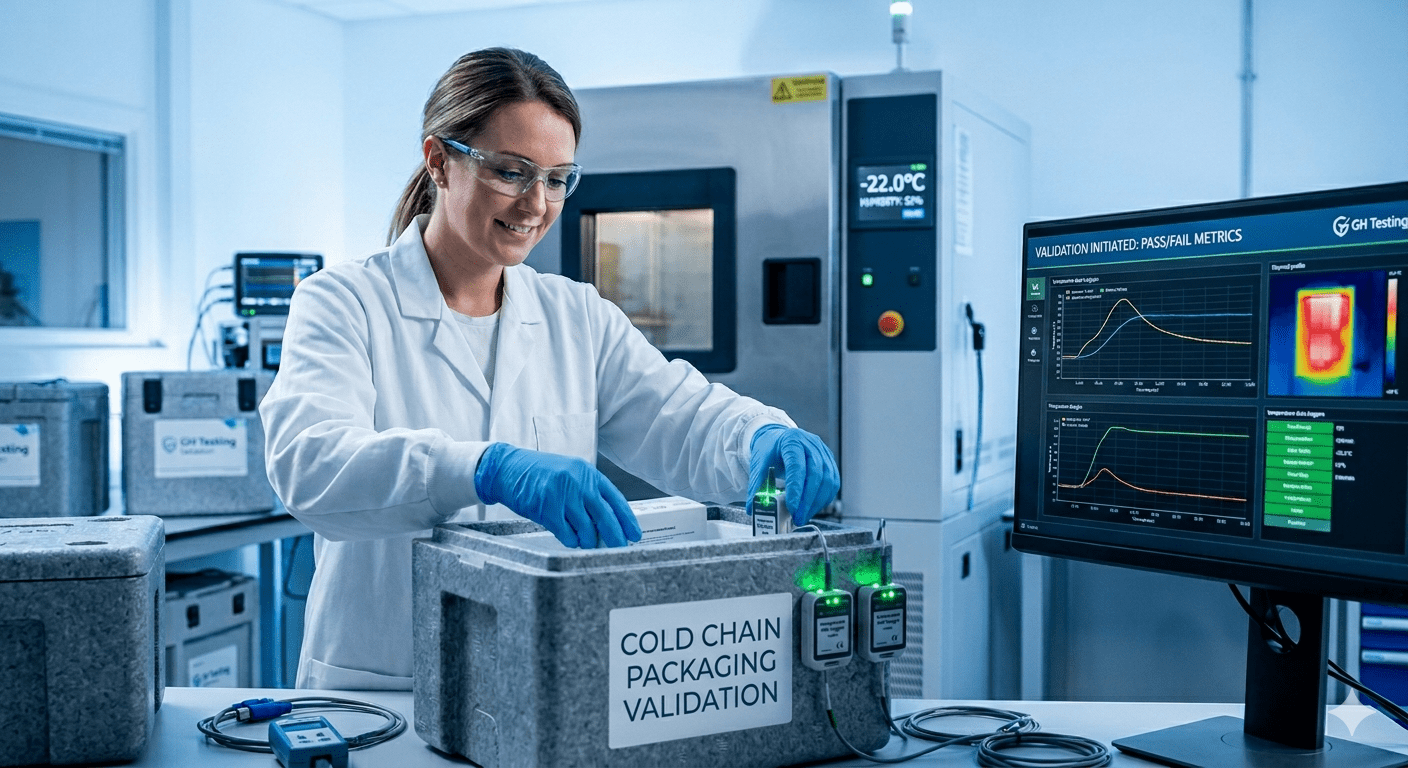
| What tests are required for cold chain packaging validation? Cold chain packaging validation requires confirming that a packaging system maintains required temperature conditions throughout the full distribution cycle — including handling, transit, staging delays, and last-mile delivery. For pharmaceutical and medical device programs, this typically includes ISTA 7D temperature-controlled distribution simulation, thermal performance testing of the insulated shipper system, freeze-thaw cycling where applicable, and temperature excursion documentation that supports regulatory submission. The specific test sequence depends on the product’s temperature sensitivity, the required temperature range, and the distribution environment the packaging will encounter. |
Cold chain packaging failure is a different category of risk than standard distribution failure. A corrugated box that gets crushed in transit is a damage claim. A temperature-sensitive pharmaceutical shipment that exceeds its required temperature range during transit is a patient safety event. The stakes are different. The validation has to reflect that.
At gh Package and Product Testing, we run cold chain packaging validation programs from our ISO 17025 accredited lab in Fairfield, Ohio, and our Phoenix, Arizona facility, which runs the same test methods and equipment.The programs we see most consistently involve pharmaceutical products, biologics, clinical trial materials, and temperature-sensitive medical devices — products where the distribution validation is not just a quality step but a regulatory requirement.
What Cold Chain Packaging Validation Actually Tests
Cold chain packaging validation is not the same as standard distribution testing with a temperature requirement added. It is a distinct validation category with its own test procedures, documentation standards, and regulatory context.
The core question cold chain validation answers is whether the packaging system — the insulated shipper, the refrigerant, the product configuration — can maintain the required temperature range across the full distribution scenario it will actually encounter. That scenario includes not just transit time but staging at ambient temperature, handling at distribution centers, last-mile delivery conditions, and any delays that are reasonably foreseeable in the supply chain.
ISTA 7D — Temperature-Controlled Distribution Simulation
ISTA 7D is the primary test procedure for cold chain distribution simulation. It evaluates the thermal performance of a complete packaging system — including the insulated shipper and refrigerant configuration — against defined distribution profiles. The test confirms whether the packaging maintains the required temperature range across a simulated distribution cycle that reflects real-world conditions including ambient temperature excursions, handling events, and transit duration.
ISTA 7D is the procedure gh runs for pharmaceutical and medical device cold chain programs including temperature ranges for refrigerated products at 2 to 8 degrees Celsius, frozen products at negative 20 degrees Celsius, and controlled room temperature products where ambient excursions are the validation concern.
Freeze-Thaw Cycling
For products that must not freeze — biologics, certain vaccines, and protein-based pharmaceuticals — freeze-thaw cycling validates that the packaging system prevents unintended freezing during cold ambient or frozen refrigerant conditions. The test evaluates whether the insulated system’s thermal mass and refrigerant configuration protect against both temperature excursions above the required range and inadvertent freezing below it.
Temperature Excursion Documentation
Regulatory submissions for pharmaceutical and medical device products require documentation that packaging has been validated across the intended distribution environment. Temperature excursion documentation records the thermal performance data from the test program in a format suitable for inclusion in regulatory files — including IND, NDA, BLA, and 510k submissions where distribution packaging validation is a required component.
Insulated Shipper Performance Qualification
Before a cold chain packaging system can be validated for distribution, the insulated shipper must be qualified — confirming that the thermal system performs as intended under defined conditions. Performance qualification testing evaluates the shipper at the specified refrigerant configuration, payload weight, and ambient temperature profile. Programs that skip this step and proceed directly to distribution simulation often discover thermal failures that could have been identified and corrected earlier in the development process.
The Distribution Profile Is Where Most Cold Chain Programs Get Into Trouble
Cold chain packaging validation is only as good as the distribution profile it tests against. A validation program that uses an idealized distribution scenario — short transit times, controlled ambient conditions, no staging delays — will pass a packaging system that fails in real-world distribution where delays, dock staging, and ambient temperature variation are the norm.
The distribution profile should reflect the worst-case scenario the packaging will realistically encounter: summer ambient temperatures for routes through warm climates, extended staging times at distribution centers, last-mile delivery in a non-temperature-controlled vehicle. Programs that define the profile too conservatively often discover this when field temperature excursion events occur after launch.
This is the same gap that shows up in extreme temperature testing more broadly — a profile built around one steady condition misses what happens when a shipment actually cycles through several climates and handling environments in a single route.
For products moving through the Amazon distribution network, West Coast distribution hubs, or international air freight with ground transfer legs, the profile needs to reflect the specific thermal hazards of those channels. gh runs cold chain programs for pharmaceutical and medical device clients with distribution networks across North America — the Phoenix lab is specifically positioned to support West Coast and Southwest distribution validation for products moving through Arizona and California.
Cold Chain Validation for Medical Device Packaging
Medical devices that require temperature-controlled storage and distribution — diagnostic reagents, certain implantables, biologics-adjacent products — require distribution validation documentation alongside sterile barrier and distribution testing for regulatory submission. The cold chain validation and the standard ISTA or ASTM distribution test sequence are not alternatives. They are complementary components of a complete validation package.
For medical device programs, gh coordinates cold chain validation with ISTA and ASTM distribution testing so the complete documentation package reflects both the thermal performance and the physical distribution hazards the packaging will encounter. This is particularly relevant for Class II and Class III device submissions where distribution packaging validation is reviewed as part of the device file. Validation timelines can also be affected by lab capacity — multi-location testing can prevent scheduling delays from becoming a submission risk.
When to Run Cold Chain Validation
Three situations require cold chain packaging validation:
- New product launch with temperature-sensitive distribution requirements. The validation needs to be complete before the product enters the distribution network — not after the first field temperature excursion.
- Packaging change. Any change to the insulated shipper design, refrigerant type, payload configuration, or packaging geometry requires revalidation. The original validation documents the original configuration.
- Distribution network change. A new distribution lane, new geographic market, or new last-mile delivery partner introduces new thermal hazards that the original validation may not have covered. If the distribution environment changes, the validation should reflect it.
If your cold chain packaging program needs validation before shipment or regulatory submission, contact us to discuss which test sequence applies to your product and distribution environment.
Frequently Asked Questions
What is the difference between cold chain packaging validation and standard distribution testing?
Standard distribution testing — ISTA 3A, ASTM D4169 — evaluates whether packaging protects a product from the physical hazards of distribution: drop, vibration, compression, and shock. Cold chain packaging validation evaluates whether packaging maintains a required temperature range across the distribution cycle. For temperature-sensitive pharmaceutical and medical device products, both validations are typically required. The physical distribution test confirms the packaging survives transit. The cold chain validation confirms the thermal system maintains the required conditions throughout that same transit.
Does cold chain packaging validation satisfy regulatory submission requirements for pharmaceutical products?
Cold chain validation documentation from gh’s ISO 17025 accredited Fairfield, Ohio lab, using ISTA 7D procedures, generates the temperature performance data and test records needed to support distribution packaging sections of IND, NDA, and BLA submissions. The specific documentation format required depends on the regulatory pathway and the regulatory agency. gh provides test reports that include the thermal performance data, distribution profile used, ambient temperature conditions, and pass-fail determination against the specified temperature range. Regulatory affairs teams should confirm the documentation format required for their specific submission with their regulatory counsel.
How long does a cold chain packaging validation program take?
Cold chain validation program duration depends on the test sequence, the number of shipper configurations being evaluated, and the distribution profile. ISTA 7D programs typically require the full distribution profile duration plus setup, conditioning, and reporting time. Programs evaluating multiple refrigerant configurations or payload variants require separate test sequences for each. A single-configuration ISTA 7D program on a standard schedule typically requires two to four weeks from sample receipt to final report. Programs with regulatory submission deadlines should build in time for any required retesting before the submission date.
Can gh Testing run cold chain validation for both Ohio and Arizona distribution routes?
Yes. gh runs cold chain packaging validation programs from both the Fairfield, Ohio lab and the Phoenix, Arizona lab. The Ohio lab serves pharmaceutical and medical device manufacturers in the Midwest and East Coast corridor. The Phoenix lab is positioned to support West Coast and Southwest distribution validation for products moving through Arizona and California distribution networks. Programs requiring validation against different geographic distribution profiles can use both lab locations within the same validation program.