
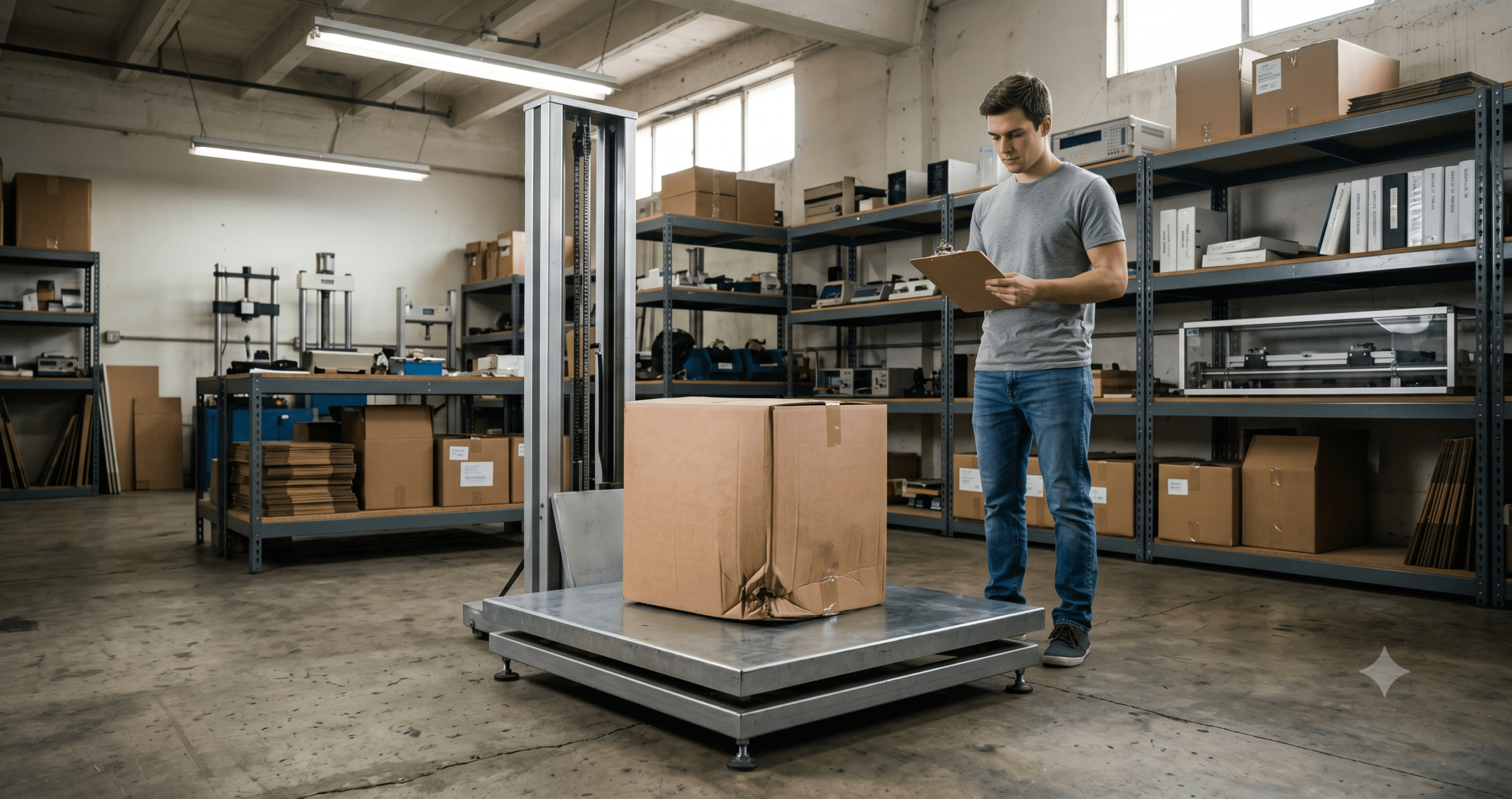
Packaging testing for startups is one of those things that doesn’t show up on most launch checklists — until a damage claim does.
| Quick Answer Packaging testing for startups typically starts with ISTA 1A or 2A for parcel-shipped products, or ISTA 6-Amazon if you’re selling through Amazon’s fulfillment network. The goal is to confirm your packaging survives the actual hazards of your distribution environment — drops, vibration, compression, and in some cases temperature extremes — before your product reaches a customer or a returns desk. |
Most startups don’t skip packaging testing on purpose. They skip it because no one told them it existed — or because it felt like something bigger companies did. By the time they find out it matters, they’re already dealing with damage claims, return rates, or a retailer asking for compliance documentation they don’t have.
This post is for founders and packaging engineers at early-stage companies who are shipping physical products and want to get testing right the first time.
Why Packaging Testing for Startups Gets Skipped
The honest answer: it’s not on most product launch checklists. Startups are focused on manufacturing, logistics, and getting to market. Packaging is treated as a cost center, not a risk variable.
The other factor is that packaging failure is invisible until it isn’t. A box that barely survives your first few hundred shipments may fail consistently at volume — when carriers are handling more packages, when seasonal heat enters the picture, or when Amazon’s sortation centers start routing your product differently.
By then, the cost of not testing is orders of magnitude higher than the cost of a test would have been.
What Actually Goes Wrong When You Don’t Test
These are the failure patterns gh Testing sees most often from companies that skipped validation:
- Product damage in transit — drops during loading and unloading that your box wasn’t designed to survive
- Compression failure — stacked pallets or conveyor pressure crushing product that passed a simple drop test
- Retailer chargebacks — big box and club store buyers will fine you for non-compliant packaging, sometimes per unit
- Amazon SIOC failures — if your product is Sold In Own Container and it doesn’t meet ISTA 6-Amazon protocol, you’re looking at re-packaging requirements or listing suspension
- Thermal damage — products that need conditioning testing (heat, cold, humidity) often aren’t tested for it until a customer complaint surfaces in July or January
None of these are edge cases. They’re common enough that we see versions of all of them every quarter.
Not sure if your current packaging is exposed to one of these? A quick test tells you before a customer does. Contact gh Testing and we’ll walk through what your product ships in and where the risk actually is.
Which Packaging Tests for Startups Actually Apply to You
The right test depends on how your product ships and where it’s going. Here’s a starting framework:
Parcel-shipped products (FedEx, UPS, USPS)
ISTA 1A is the entry-level standard — a defined sequence of drops, vibration, and compression that represents parcel handling. It’s not comprehensive, but it’s a legitimate baseline and it’s what most compliance conversations start with.
ISTA 2A goes further. It adds more hazards and better represents what a package actually encounters across a full distribution cycle. If you’re scaling volume or moving into retail, 2A is the more defensible choice.
Amazon fulfillment (FBA / SIOC)
If you’re selling through Amazon and your product ships in its own packaging without an additional outer box, ISTA 6-Amazon is the protocol. It was developed specifically for the Amazon fulfillment environment and is required for ISTA Certified Frustration-Free Packaging and Ships in Own Container certifications.
gh Testing performs ISTA 6-Amazon testing at both our Ohio and Phoenix locations.
Retail and club store requirements
Walmart, Target, Costco, and similar retailers have their own packaging requirements — often ASTM-based or custom protocols. If you’re pursuing retail distribution, ask your buyer for their packaging spec before you finalize your design.
Products sensitive to temperature or humidity
If your product can be affected by heat, cold, or moisture — food, beverage, personal care, electronics, pharma, anything with adhesives or seals — conditioning should be part of your test sequence. This is where ISTA protocols that include environmental preconditioning become relevant, and where a chamber test can catch failures that a mechanical test alone would miss.
When in the Product Development Cycle Should Startups Test Packaging
Sooner than you think. The best time to test is during the packaging design phase, before you’ve committed to tooling or placed a production order. A test failure at that stage costs you a redesign. A test failure after you’ve shipped 5,000 units costs you returns, replacements, and potentially a customer relationship.
Minimum viable testing timeline:
- Design validation — test your prototype packaging before production
- Production validation — test samples from your first production run, not just the prototype
- Ongoing spot checks — if your supplier changes materials or your carrier mix shifts, retest
If you’ve already launched without testing, that’s fine — come in now. A test at this stage tells you what you’re actually exposed to and gives you a documented baseline going forward.
What to Expect When You Work With a Packaging Testing Lab
The process is more straightforward than most founders expect. You ship samples to the lab — typically 6 to 10 units depending on the protocol — and the lab runs the test sequence and gives you a report showing pass, fail, and the specific points of failure if applicable.
Turnaround time varies by protocol and lab scheduling. At gh Testing, most ISTA 1A and 2A projects run within a standard lead time, and rush scheduling is available when timelines are tight.
The report you receive is documentation you can use with retailers, carriers, or internal stakeholders. It’s not just a test result — it’s evidence that your packaging was validated before it went to market.
At gh Testing, that report comes with a direct conversation with the person who ran your test — not a call center and a case number. We’ve been doing this since 1987, and we still treat a startup’s first test the same way we treat a Fortune 500 program: same attention, same documentation standard.
Frequently Asked Questions
How much does packaging testing cost for a startup?
The cost depends on the protocol, the number of samples required, and your turnaround timeline. ISTA 1A is typically the most accessible entry point. The more useful question is: what does a damage claim, a return wave, or a retailer chargeback cost you? Testing is almost always cheaper than the failure it prevents. Contact gh Testing for a quote based on your specific product and distribution channel.
Can I send just one or two samples for packaging testing?
Most ISTA protocols require a minimum number of samples to complete the full test sequence — typically 6 to 10 units. This isn’t arbitrary: the protocol is designed to test multiple hazards, and some samples are consumed or compromised during testing. Running the full protocol with adequate samples gives you a valid, defensible result.
Do startups need ISO 17025 accredited testing?
If you’re pursuing Amazon certification, selling to major retailers, or operating in a regulated category like medical devices or pharma-adjacent products, yes — accredited test data is often required or strongly preferred. Even outside those requirements, our Fairfield, Ohio lab’s ANAB accreditation to ISO/IEC 17025 Testing means its methods and equipment have been independently verified.
What’s the difference between ISTA and ASTM packaging tests?
ISTA (International Safe Transit Association) protocols are sequence-based — they simulate the full distribution environment as a series of hazards in order. ASTM methods are individual test methods (a drop test, a vibration test, a compression test) that can be combined into a custom protocol or used to meet a specific retailer requirement. Many startups start with an ISTA protocol and add ASTM methods as their distribution channels get more complex. gh Testing performs both.
If you’re launching a physical product and packaging validation isn’t part of your process yet, that’s where we start. Tell us how your product ships and we’ll tell you which test applies — no obligation, no sales pitch, just a straight answer. gh Testing runs ISTA and ASTM protocols at our labs in Fairfield, Ohio and Phoenix, Arizona. Contact us or call 513-870-0080.