
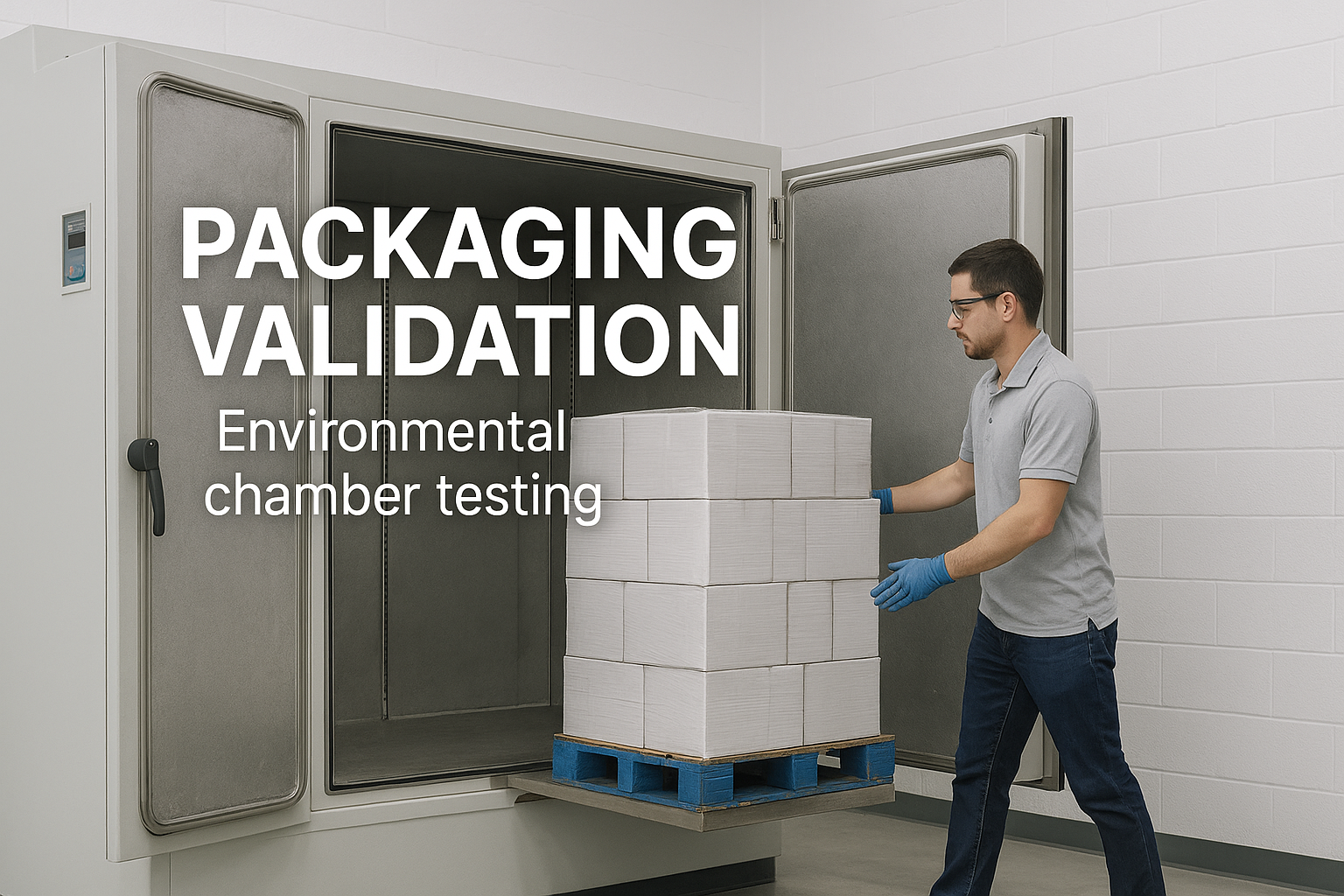
| What does environmental and temperature chamber testing actually reveal about packaging? Environmental chamber testing exposes packaging and product to controlled heat, cold, and humidity extremes — replicating conditions a shipment or long-term storage cycle actually produces. It catches failures a mechanical test alone misses: adhesive softening, seal degradation, film brittleness, and material behavior changes that only appear once temperature and humidity are part of the sequence, not just drop and vibration. |
Partnering with gh Testing to Ensure Performance and Compliance
Packaging that passes a drop test can still fail in the field — and heat, cold, or humidity is usually why. A seal that holds at room temperature can release at 100°F. An adhesive that looks fine on the bench can soften in a non-climate-controlled trailer sitting at a dock for six hours. Environmental testing is how you find that failure in a lab instead of in a customer’s hands.
At gh Testing, our Ohio lab is ISO 17025 accredited; our Phoenix lab runs the same environmental and temperature chamber testing programs. Both locations run controlled exposure sequences designed to replicate the actual conditions your product and packaging will encounter, not a generic worst case.
What Environmental Chamber Testing Actually Tests
Environmental and temperature chamber testing subjects packaging to controlled extremes of heat, cold, and humidity to reveal how materials, adhesives, seals, and closures actually respond — not how they’re assumed to respond. Whether you’re qualifying a new film, validating packaging for long-term storage, or evaluating product durability under climate stress, this is the step that catches what a mechanical-only test sequence can’t.
For CPG teams shipping through summer without a chamber test on record, this is usually where an unexpected field failure traces back to.
Our Environmental Testing Capabilities
- Temperature range: –70°C to +180°C
- Humidity range: 10% to 98% relative humidity
- Profiles: steady state, ramp rate, temperature cycling, and custom environmental simulations
- Six environmental chambers, supporting a wide range of product sizes and packaging formats
Every test runs under controlled conditions with full documentation, calibration, and traceable measurement systems.
What You Receive
- Continuous data logging with time-stamped temperature and humidity readings
- Full photographic documentation of setups and sample condition after exposure
- Graphical reports that visualize temperature and humidity profiles
- Root-cause analysis and performance interpretation for product improvement
- Audit-ready reports formatted for regulatory or customer submission
If your packaging has only ever been tested for drop and vibration, environmental exposure is the gap most programs don’t find until a shipment already failed. Contact gh Testing to talk through which conditioning profile applies to your product.
Where Environmental Testing Matters Most
- Pharmaceutical and biotechnology — confirming packaging integrity and label adhesion under controlled environmental conditions
- Consumer packaged goods (CPG) — evaluating product and packaging performance for food, beverage, cosmetics, and household products through temperature and humidity exposure
- Industrial and electronics — assessing durability, seal performance, and component reliability under extreme temperature conditions
- Packaging and materials — characterizing film strength, barrier performance, adhesive behavior, and seal integrity through controlled exposure
Frequently Asked Questions
Does environmental testing replace mechanical testing like ISTA or ASTM sequences?
No — they answer different questions. Mechanical testing (drop, vibration, compression) confirms packaging survives physical handling. Environmental testing confirms it survives the temperature and humidity conditions of that same distribution or storage cycle. Most complete validation programs run both, often as an integrated sequence.
How do I know which temperature and humidity profile applies to my product?
It depends on your distribution route and storage conditions — a product shipped through summer in the Southwest faces a different exposure than one stored in a climate-controlled warehouse year-round. Telling us your shipping lanes and storage conditions lets us recommend the right profile rather than defaulting to a generic worst case.
Can environmental conditioning be combined with mechanical testing in one sequence?
Yes — this is standard practice for a complete validation program. Conditioning typically runs before the mechanical sequence, so the packaging is tested in the state it will actually be in when handling stress hits it, not in an unconditioned baseline state.
A Partner for Packaging Engineers
At gh Testing, we act as an extension of your engineering and quality team — not a black-box contract lab. We collaborate directly with packaging engineers and quality leaders to define test profiles, interpret data, and provide findings you can actually act on, with direct access to the engineers running your test rather than a project coordinator relaying messages.
If your packaging hasn’t been tested under real temperature and humidity conditions yet, that’s worth a conversation before your next shipment, not after a field failure. Contact gh Testing or call 513-870-0080.