
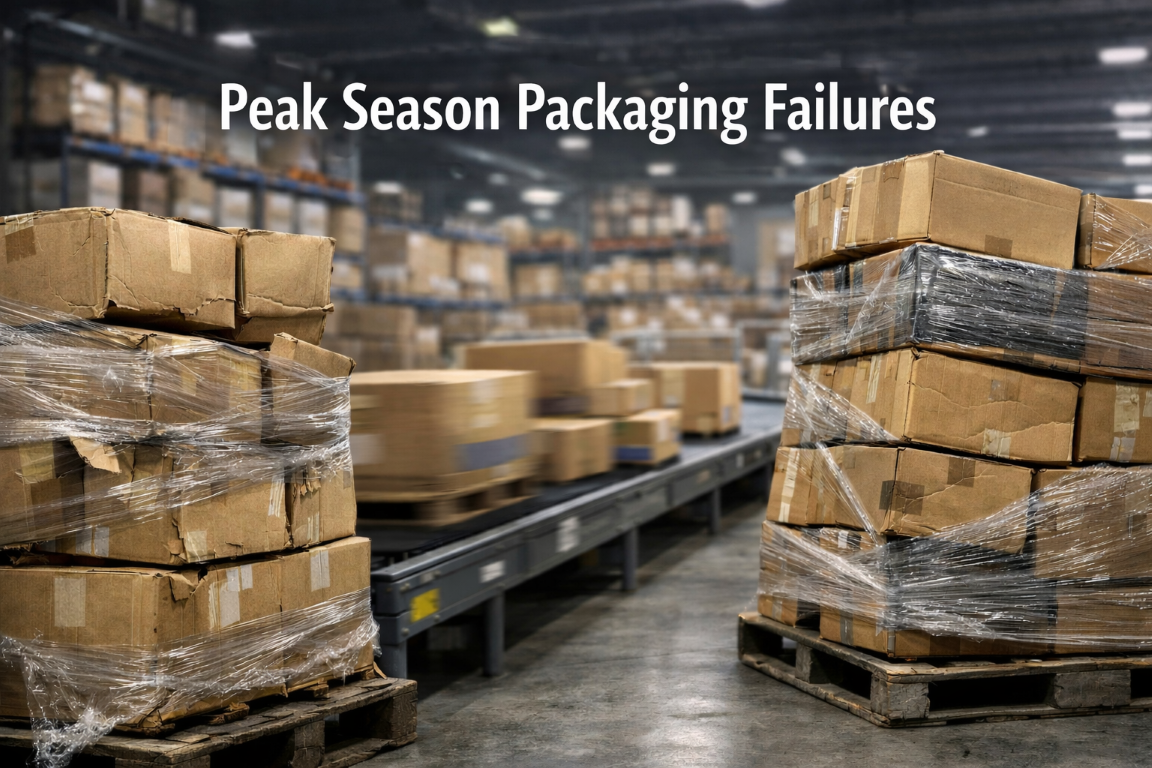
| What should you do when packaging that passed testing still fails during peak season? Treat the failure as data, not a verdict on your test program. Document where in the distribution cycle the failure occurred, wait until volume stabilizes, and use that real-world performance data to refine — not restart — your validation strategy. Packaging that failed at peak volume usually didn’t fail the test it was built for; it encountered conditions beyond what that test covered. |
Every year during peak shipping season, packaging teams start seeing the same pattern: damage claims increase, field failures appear, and products that passed testing earlier in the year suddenly struggle. The first reaction is almost always “but we tested this” — and that reaction, while understandable, usually points teams in the wrong direction.
At gh Testing, we see this pattern every year across multiple industries. When packaging problems show up during peak volume, it doesn’t mean the testing was wrong. It usually means the packaging encountered real-world stress combinations — vibration, compression, and environmental exposure happening together, at a scale — that a standard test plan doesn’t fully replicate.
Testing Wasn’t Wrong. It Was Incomplete for Peak Conditions.
Most teams follow standards correctly: they validate to the applicable ISTA or ASTM procedure, test representative samples, and document results properly. Peak season doesn’t expose poor discipline — it exposes the gap between normal operating assumptions and peak operating reality.
The package passed the test it was designed for. Peak season simply pushed it further than that test was built to check. We cover exactly where those specific gaps tend to show up here — vibration duration, compression assumptions, and environmental conditioning are the three most common.
What Experienced Packaging Teams Do After Peak Season
Teams with experience don’t panic when issues appear late in the year. They document what happened, capture field data, and wait until shipping volume stabilizes before making changes.
Then they ask sharper questions:
- Where in the distribution cycle did the failure actually occur?
- Did vibration, compression, or environmental exposure play the biggest role — or some combination of the three?
- Does the test plan need additional transportation simulation or environmental conditioning to reflect what just happened?
This is where testing adds the most value — not as a reaction, but as a refinement.
Why Post-Peak Testing Often Delivers Better Insight Than a Pre-Launch Test
After peak season, teams have something they didn’t have before: real-world performance data. That data guides adjusted vibration profiles, updated compression assumptions, environmental conditioning refinements, and packaging design changes that are targeted rather than excessive.
Testing informed by field results is almost always more efficient than adding margin without data — you’re fixing the specific gap that failed, not over-engineering the whole package out of caution.
If packaging issues showed up this peak season, the next step isn’t guesswork — it’s a focused review of where the failure actually happened. Contact gh Testing to talk through what your field data is telling you.
Frequently Asked Questions
Should I redesign my packaging immediately after a peak-season failure, or wait?
Wait until volume stabilizes and you’ve gathered enough field data to know exactly where and how the failure occurred. A redesign made in the middle of peak season, before you know the root cause, risks fixing the wrong thing or over-engineering the packaging unnecessarily.
Does a peak-season failure mean my original test program was inadequate?
Not necessarily. Most peak-season failures come from real-world stress combinations exceeding what a standard test plan represents, not from the original testing being done incorrectly. The distinction matters — it changes whether you need a different test protocol or an expanded one, not a completely new validation approach.
What data should I collect before bringing a packaging failure back to a testing lab?
As much specificity as possible about where in the distribution cycle the damage occurred — which leg of transit, what handling point, what conditions (temperature, stacking, carrier) were present. That detail is what lets a lab target the retest at the actual gap instead of re-running the full original test plan from scratch.
What This Means Going Forward
Peak shipping doesn’t mean your packaging program failed — it means your packaging encountered its most demanding conditions. Teams that treat peak season as a stress audit, use failures as inputs instead of blame, and refine their validation strategy based on observed performance end up with stronger packaging and fewer surprises heading into the next cycle.
If packaging issues are showing up right now, you’re not alone, and you’re not behind. Contact gh Testing today to talk through your project.