
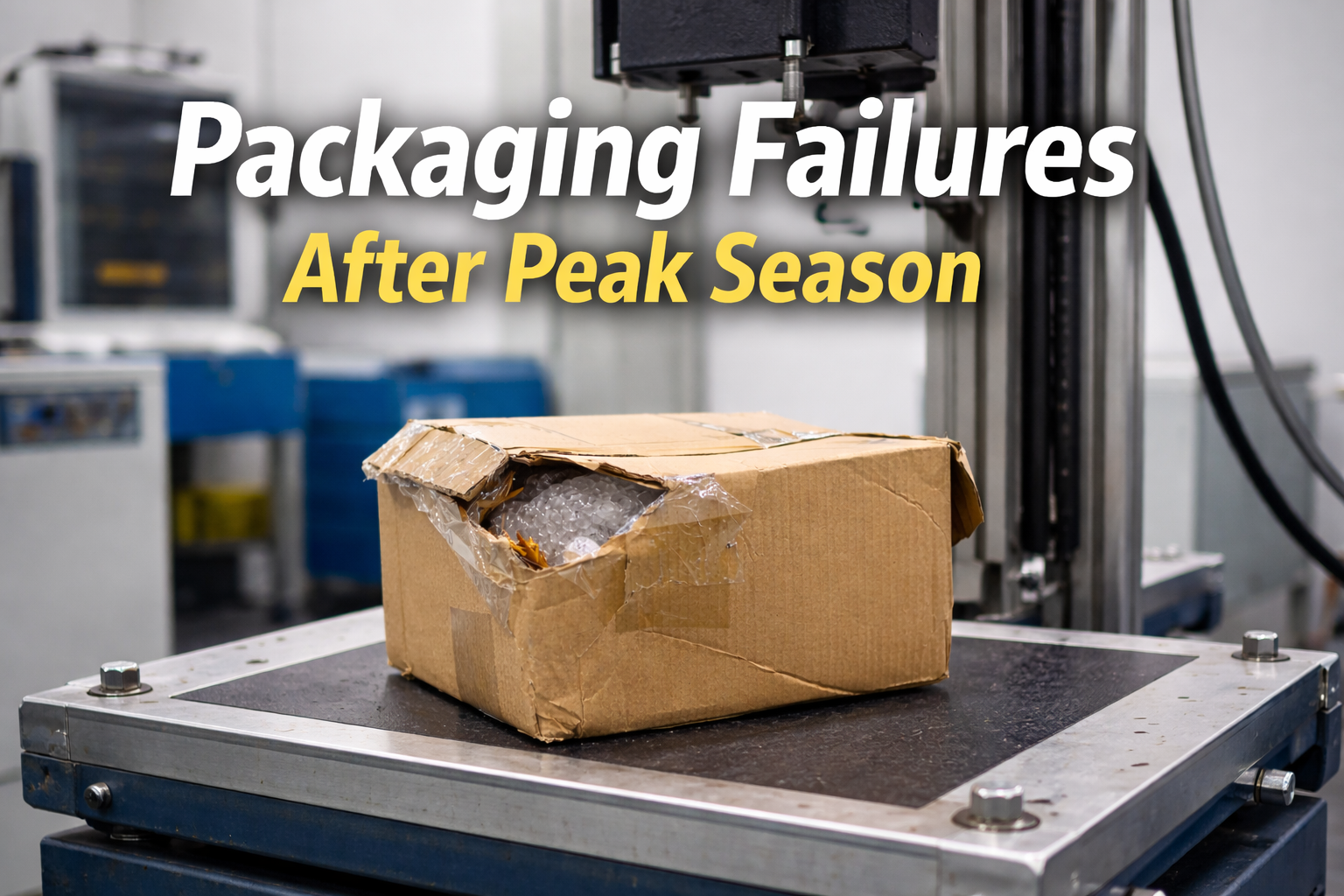
| Why does packaging that passed testing still fail during peak shipping season? Peak season doesn’t add a new hazard — it intensifies the ones your test program may have only checked at baseline levels. Higher conveyor speeds, taller pallet stacks, longer trailer dwell times, and colder late-year temperatures push vibration, compression, and environmental stress past what a single-procedure test plan typically covers. The packaging didn’t fail the test. The test didn’t cover peak conditions. |
Packaging failures after peak season often surprise teams because the packaging already passed required lab tests. Yet once shipping volume increases, handling becomes less controlled, and transit times extend, damage appears that was never seen during validation. In most cases, the issue isn’t that testing was skipped — it’s that the selected tests didn’t fully represent peak-season conditions.
Here’s a technical look at where the three most common gaps show up, and how to close them before the next commercial release.
Vibration Exposure Is Often Underestimated
Vibration is one of the most common contributors to damage during high-volume shipping. Low-level vibration over long durations degrades cushioning, loosens fasteners, and shifts product orientation inside the package — cumulative fatigue that a single drop test never surfaces.
ASTM vibration testing and full parcel simulations like ISTA 3A are built to represent these conditions. When vibration testing is reduced or omitted in favor of drop testing alone, packages can pass validation and still fail in the field from fatigue that only shows up over time and distance.
Compression and Stack Height Assumptions Break Down
During peak season, warehouses and trailers get packed more tightly to maximize capacity. Compression forces increase, and stack heights often exceed the assumptions a test plan was built around earlier in the year.
ASTM compression testing quantifies how a package performs under sustained load — but only if the stack heights and safety factors used in the test reflect what actually happens at peak volume, not what was assumed during a slower shipping period.
Environmental Conditioning Is Often Skipped or Minimized
Temperature and humidity swings are amplified during peak season — longer transit times and more outdoor staging mean more exposure to cold docks, hot trailers, and humid environments, all of which affect material performance.
When environmental conditioning isn’t combined with mechanical tests like drop or vibration, packaging can look robust in the lab and still degrade under real distribution conditions — a pattern we cover in more depth here.
If packaging failures showed up this past peak season, the fix usually isn’t more packaging — it’s closing the specific test gap that let it through. Request a packaging risk review to find out which of these three is actually behind yours.
Frequently Asked Questions
If my packaging already passed ISTA testing, why did it fail during peak season?
Passing a baseline ISTA procedure confirms the packaging handles standard distribution stress — it doesn’t automatically confirm performance at peak-volume intensity. Peak season compounds vibration duration, compression load, and environmental exposure simultaneously, which a single standard procedure may not have tested together.
Which test should I add first if I only have budget for one?
It depends on where the damage is actually occurring — a review of where in the distribution cycle failures showed up (loading, transit, staging, last-mile) usually points to whether vibration, compression, or environmental conditioning is the biggest gap, rather than guessing at all three.
Does peak-season testing need to happen every year, or just once?
If your distribution network, product weight, packaging design, or carrier mix changes, retesting is worth it — peak-season stress patterns shift with any of those variables, so a test plan built for last year’s peak season may not reflect this year’s actual conditions.
Practical Takeaways for Reducing Risk
Testing should reflect worst-case distribution conditions, not minimum compliance. That usually means moving beyond a single procedure and combining mechanical tests with realistic environmental conditioning — selecting the right mix of ISTA procedures, ASTM methods, and conditioning profiles early enough to catch failure modes before products ship at scale.
For a broader look at what happens after failures show up and how to turn them into a stronger test plan rather than a one-off fix, see what experienced teams do after a peak season failure.