
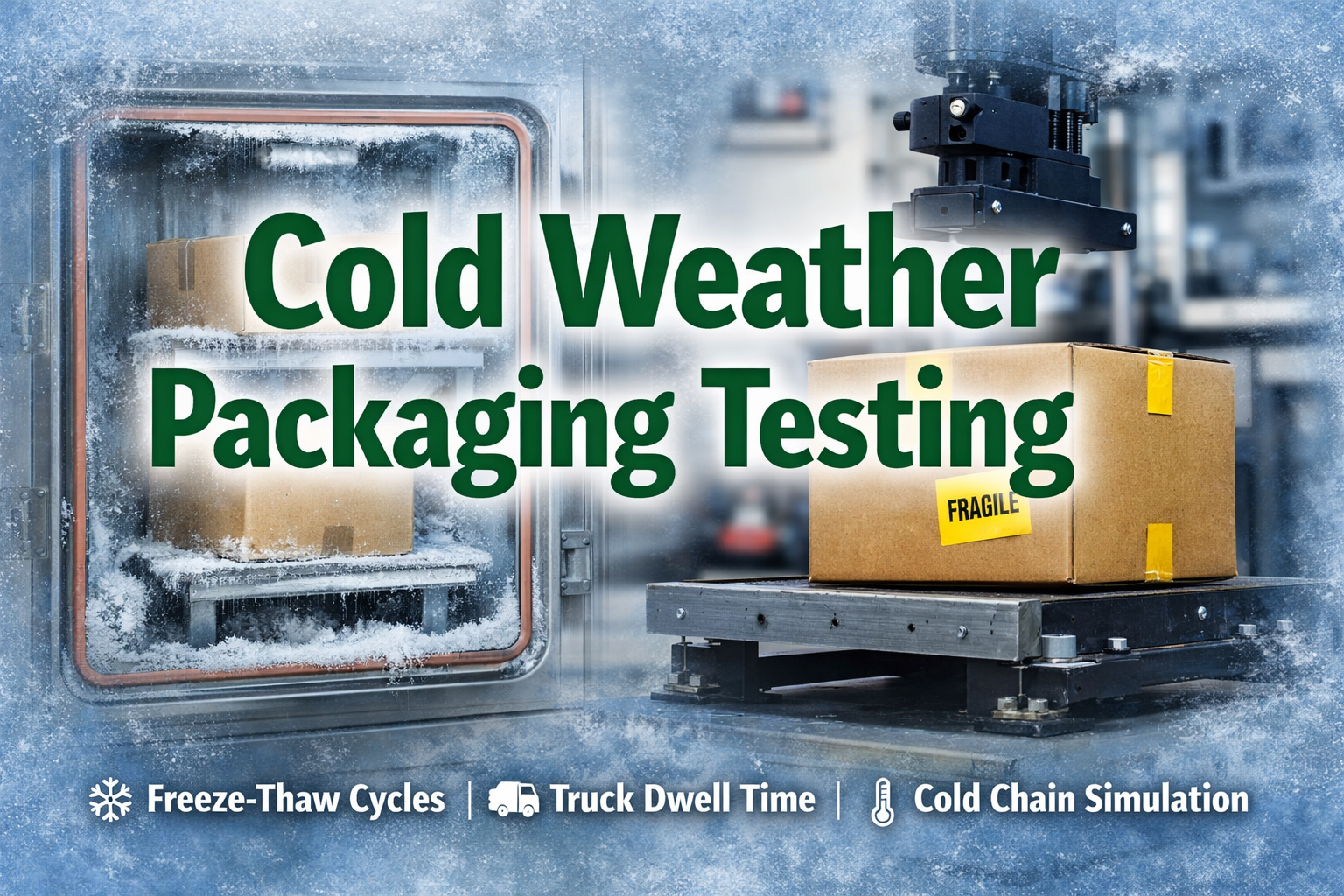
| Does cold weather packaging testing matter even if my product doesn’t ship from a cold climate? Yes — the risk isn’t where your lab or warehouse is located, it’s where the product travels through. Winter shipping routes, refrigerated warehouses, and cold-chain freight networks expose packaging to freeze-thaw cycling and extended cold dwell time regardless of climate at the origin or destination. A product shipping through the Southwest still passes through cold storage, overnight freight in unheated trailers, and winter mountain routes on its way to market. |
Many packaging systems perform well in controlled conditions, yet fail once winter shipping begins. Cold weather packaging testing is often treated as optional — even for products moving through uncontrolled truck routes, outdoor transfer points, and regional hubs during cold months.
For medical, pharmaceutical, and temperature-sensitive products, winter exposure introduces risks that standard room-temperature distribution testing doesn’t capture — and the cost of missing that gap isn’t a lab finding, it’s a field failure with a patient or customer on the other end of it.
Why Cold Weather Testing Gets Overlooked
Most validation programs focus on drops, vibration, and compression at room temperature. Those tests are essential, but they assume materials behave consistently across seasons — they don’t.
Cold temperatures change material stiffness, cushioning response, adhesive performance, and seal integrity. Without cold weather testing specifically, teams miss failures that only appear after extended exposure to low temperatures — meaning the packaging that passed validation in June can still fail in January, on the exact same product, with no design change in between.
Freeze-Thaw Cycles Create Hidden Damage
One of the most common winter failure modes is freeze-thaw exposure. Products experience repeated temperature swings as shipments move between trailers, docks, and temporary storage — and these cycles cause cracking, delamination, leakage, or loss of cushioning performance that a single-temperature test never reveals.
gh Testing conditions samples through controlled cold exposure followed by distribution testing specifically to catch this — a package tested only once, at one temperature, tells you nothing about what happens on cycle three of a real winter shipment.
Truck Dwell Time Is Often the Real Risk
Many winter failures don’t happen during transit — they happen during delays. Extended truck dwell time exposes packages to sustained cold without movement, allowing materials to fully equilibrate to low temperatures. That increases brittleness and reduces impact resistance right before the package finally gets handled again at the next dock.
Cold conditioning followed by ASTM drop testing or ISTA distribution sequences is often necessary to replicate this risk accurately — a package conditioned briefly and tested immediately doesn’t reflect a truck that sat overnight at a distribution center.
If your product ships through cold storage, winter freight, or extended dwell time and hasn’t been conditioned for it, that gap usually surfaces as a field failure, not a lab finding. Contact gh Testing for a Cold Weather Readiness Review — tell us your shipping route and dwell points, and we’ll tell you where the exposure actually is.
Combining Environmental Conditioning With Distribution Testing
Effective cold weather testing combines temperature exposure with mechanical stress. Both our Ohio and Phoenix labs condition samples to cold, heat, or humidity levels before performing ISTA procedures such as 1A or 3A, as well as ASTM drop, vibration, and compression testing — the same equipment, methods, and conditioning capability at either location.
This reveals how packaging performs after real environmental exposure, not just under ideal lab conditions.
Cold Weather Testing for Medical and Pharma Products
This matters most for medical and pharmaceutical products shipping through uncontrolled environments — temperature exposure, dwell time, and distribution stress interact in ways room-temperature testing alone won’t catch. This is true whether the shipment originates from the Midwest or moves through Southwest distribution networks; cold-chain freight, refrigerated warehousing, and winter routing don’t stop at a state line, and neither should your test plan.
The Decision Rule
If your product ships during winter months, or moves through any cold storage or refrigerated freight network, cold exposure should be treated as a core risk — not a special case reserved for products that visibly ship from cold climates. Cold weather testing is most valuable when it simulates temperature effects and distribution stress together; testing only one without the other leaves a critical gap before commercial release.
Frequently Asked Questions
Does my product need cold weather testing if it doesn’t ship from or to a cold-climate region?
Likely yes, if it moves through any cold storage, refrigerated freight, or winter shipping route at any point in its distribution path — the risk comes from what the shipment passes through, not where the shipper or receiver is located.
What’s the difference between testing at a single cold temperature and freeze-thaw cycling?
A single cold-temperature test shows how packaging performs at one static condition. Freeze-thaw cycling repeats temperature swings the way a real shipment actually experiences them — moving between trailers, docks, and storage — which is what actually causes cracking, delamination, and seal failure in the field.
Can gh Testing run cold weather validation at either the Ohio or Phoenix lab?
Yes. Both labs run the same environmental conditioning and distribution testing capability — cold, heat, and humidity conditioning combined with ISTA and ASTM mechanical sequences — so location is a matter of convenience for your team, not a difference in test capability.
Get Help Selecting the Right Cold-Chain Test
If you need to simulate winter exposure, freeze-thaw cycling, or extended cold dwell time, gh Testing can help determine the right test approach for your specific shipping route.
Tell us your product and distribution path, and we’ll tell you where the cold-weather exposure actually is — before a January shipment tells you first. Contact gh Testing or call 513-870-0080.