
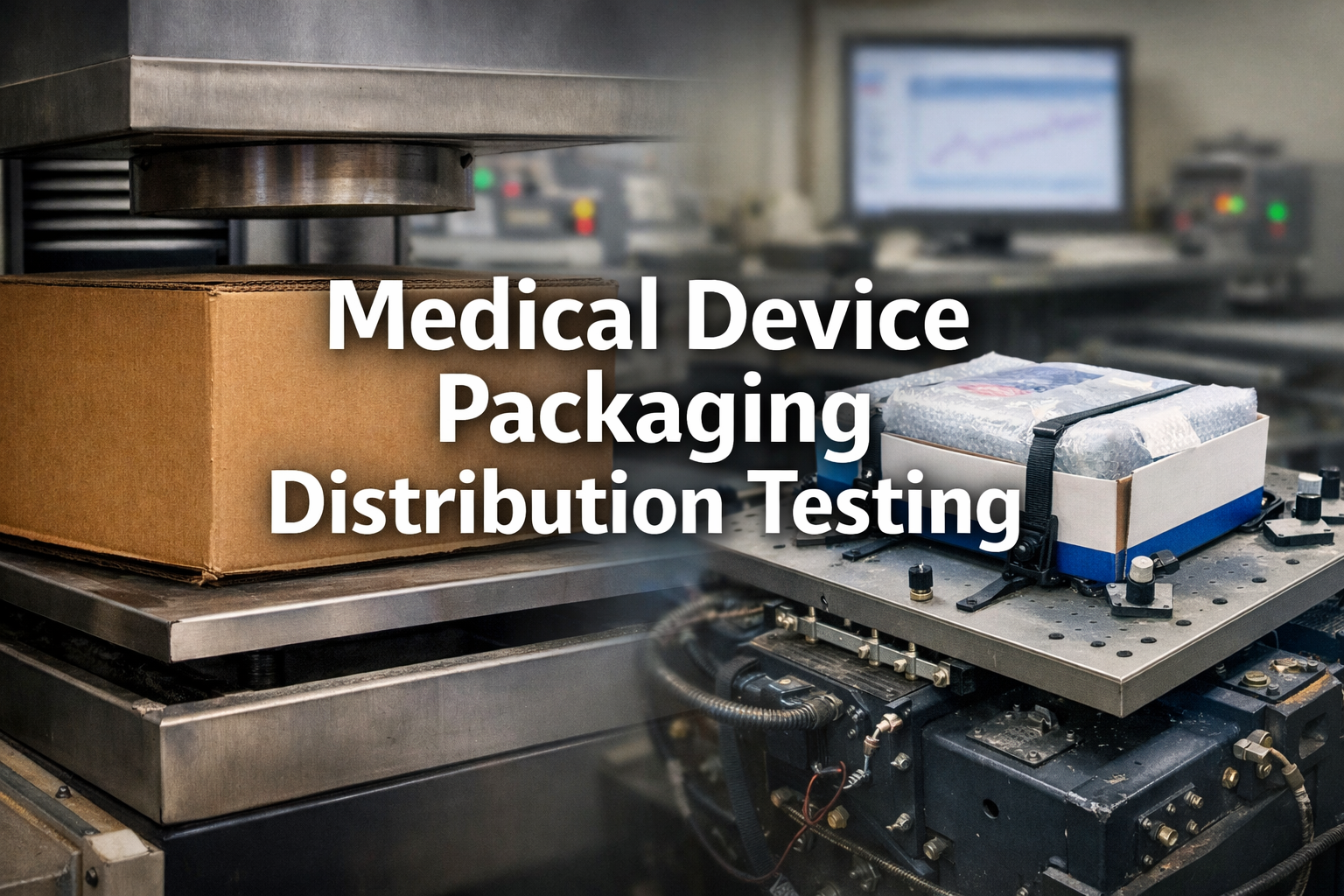
Medical device packaging distribution testing often passes in the laboratory but fails under real-world distribution conditions. When sequencing and environmental variables are not aligned with actual supply chain exposure, hidden failure modes emerge.
It shows up after shipment.
In my experience, most field failures are not caused by missing tests. They’re caused by assumptions inside the validation plan. Assumptions about sequence, environment, and how materials behave after exposure to vibration and humidity.
That’s where problems begin.
Where Medical Device Packaging Distribution Testing Fails
Most medical device programs rely on ISTA 3A or ASTM D4169 Distribution Cycle 13. Both are valid standards. Both can produce solid data.
The issue isn’t the standard. It’s how it’s executed.
In the lab, compression may be run at 23°C and 50% RH. Vibration may be performed on a dry, structurally intact shipper. Drop testing may occur before the package has experienced any fatigue.
In distribution, none of those variables exist in isolation.
Humidity increases. Stacking loads persist. Vibration accumulates. Materials soften. Internal supports fatigue.
A test that passes as a sequence of isolated events can still fail as a cumulative system.
Compression Performance Changes With Humidity
Corrugated containers are sensitive to moisture. As relative humidity rises, edge crush strength and bending stiffness decline.
If compression testing is performed at nominal lab conditions, recorded stacking strength in lbf may look acceptable. After exposure to elevated RH, that same structure may lose enough stiffness that even moderate stacking load becomes critical.
Now add vibration.
Once internal supports have experienced fatigue, compression safety margins narrow further. Panel buckling in a humid distribution center is often the result of this interaction.
It is rarely a surprise if the sequence is evaluated correctly.
Vibration Fatigue Is Time-Driven, Not Just G-Driven
Random vibration testing replicates transport inputs in terms of G-force. What it does not automatically capture is cumulative fatigue.
Short-duration vibration profiles may not reveal:
- Cushion creep under sustained load
- Device migration inside secondary packaging
- Micro-abrasion of sterile barrier materials
- Progressive reduction in residual compression strength
For biomedical and pharmaceutical packaging, sterile barrier failures often occur because abrasion accumulates over time. The damage mechanism is subtle. The seal doesn’t rupture during the test. It degrades gradually.
That degradation usually begins earlier than the final failure point.
ISTA 3A and ASTM D4169: The Standards Are Not the Problem
Both ISTA 3A and ASTM D4169 provide structured distribution simulation.
Where gaps appear is in how environmental conditioning and sequencing are treated.
If conditioning is minimized to accelerate scheduling, material behavior is misrepresented. If drop testing is performed before vibration rather than after, impact resistance is overstated.
The standards themselves allow for robust validation. The real question is whether the test plan reflects cumulative distribution exposure.
Official guidance from ISTA and ASTM makes it clear that atmosphere and sequence are variables, not optional details.
https://ista.org
https://www.astm.org
Environmental Variables in Medical Device Distribution Testing
Environmental conditioning is not just a preparatory step. It changes performance.
High RH reduces ECT retention in corrugated packaging.
Cold exposure increases brittleness in certain polymers.
Elevated temperature can accelerate adhesive creep.
If compression, vibration, and drop testing are not performed while materials remain equilibrated to those environments, the data does not reflect actual supply chain conditions.
That disconnect is a common source of medical device packaging distribution testing failures.
Cold Chain and Aging Add Another Layer
For temperature-sensitive or cold chain medical devices, the interaction becomes more complex.
Freeze-thaw cycles can introduce brittleness. Transition from cold storage to humid environments increases condensation and moisture absorption. Insulated systems may perform thermally while still degrading structurally under vibration and stacking.
Similarly, accelerated aging changes material response. Aged adhesives, films, and corrugated do not respond the same way under compression and vibration as new materials.
Shelf-life validation and distribution validation should not be isolated discussions. They influence each other.
How to Strengthen Medical Device Packaging Validation Before Release
If you are validating medical device packaging for distribution, consider:
- Performing compression testing after humidity conditioning
- Running drop testing after vibration, not before
- Evaluating vibration duration as a fatigue mechanism
- Monitoring internal device movement within secondary packaging
- Accounting for environmental exposure as a structural modifier
At gh Testing, we evaluate these interactions using ISTA 1A, 3A, and 6-series procedures, ASTM D4169 distribution cycles, ASTM D5276 drop testing, ASTM D4728 vibration testing, and controlled environmental chamber conditioning for heat, cold, and humidity.
You can review the full suite of gh Testing’s Medical Packaging Testing capabilities.
Request a Distribution Risk Gap Review
If your packaging consistently passes validation but fails after shipment, the issue is often not compliance. It is sequence, environment, or cumulative load interaction.
Request a review of your current test sequence to identify distribution risks before they show up in the field.
Summary
Medical device packaging distribution testing failures rarely indicate a broken standard.
More often, they reveal a validation plan that did not fully account for how environment, vibration, compression, and time interact across the supply chain.
When validation reflects cumulative stress rather than isolated events, packaging performance aligns more closely with real-world distribution.
That shift is where risk reduction actually happens.