
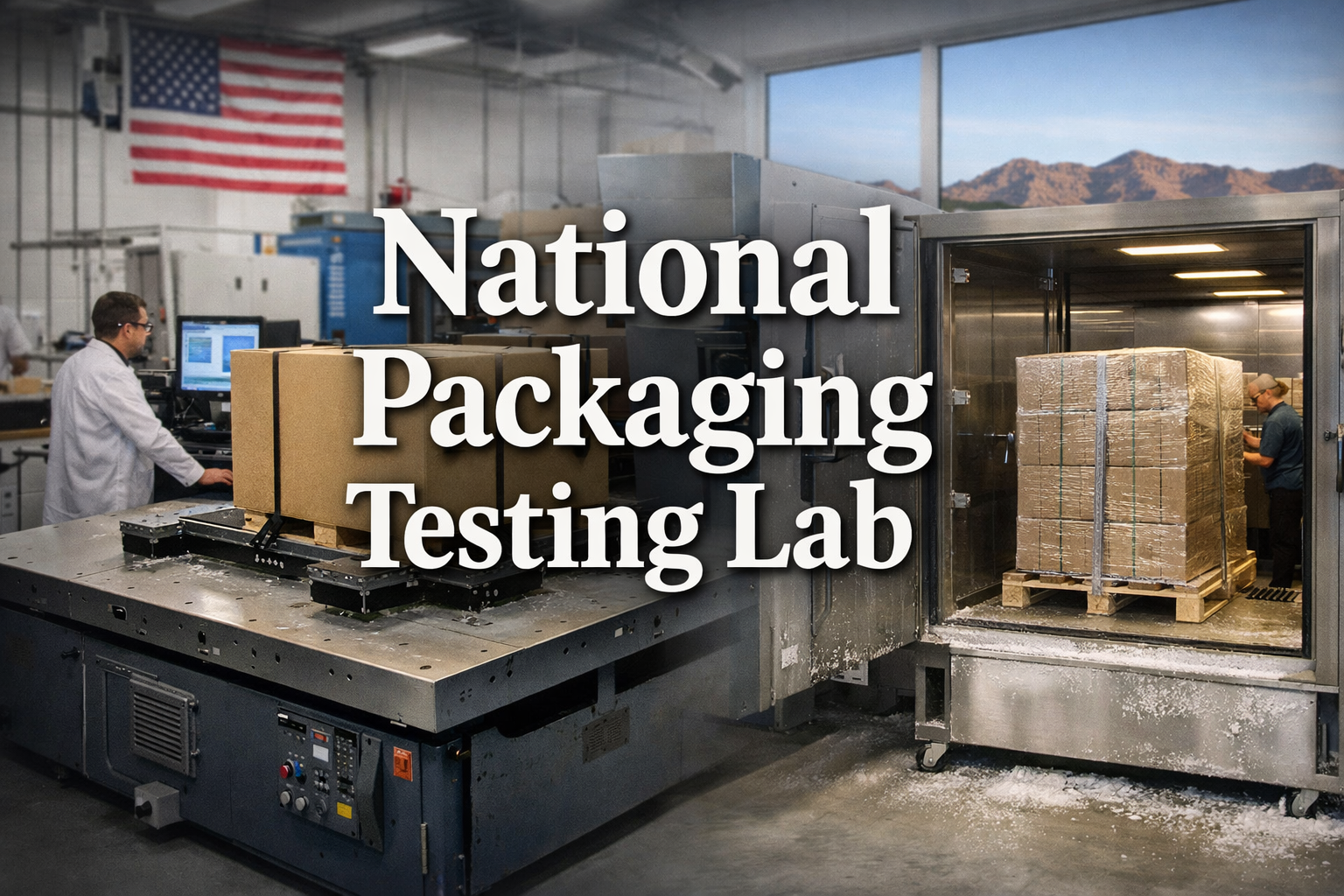
| What is a national packaging testing lab, and why does it matter for validation timelines? A national packaging testing lab runs ISTA and ASTM test programs across more than one facility, so vibration, compression, and environmental conditioning can happen in parallel instead of queuing one after another at a single site. A single delayed chamber slot at a one-location lab can add a week or more to a validation timeline — and for programs with hard launch dates, that’s often the difference between a product shipping on schedule and a launch slipping past a committed date. |
When a validation schedule slips, the packaging design is rarely the problem. Lab capacity is. A single-location lab can only run so many sequences at once — and during peak seasons, medical device launches, CPG resets, and industrial changeovers all compete for the same vibration tables and environmental chambers. A queue that adds even a few days can be the difference between a validated product shipping on schedule and a launch date slipping past a committed regulatory or retail deadline.
Launch delays often start exactly there: in the queue, not in the lab.
Why a National Packaging Testing Lab Prevents Validation Bottlenecks
A national packaging testing lab avoids single-site queuing by running programs across multiple facilities at once. While one location completes ISTA vibration and drop testing, another can begin compression or environmental conditioning on a different program — the same total capacity, running in parallel instead of stacked in sequence.
For a medical device team working toward a submission deadline, that difference is measured in days that actually matter — a chamber slot that opens next week instead of next month can be the gap between filing on time and explaining a delay to regulatory affairs.
Parallel ISTA and ASTM Testing Across Locations
ISTA 1A, 3A, and 6-Amazon procedures each require their own sequencing, and ASTM D4169 distribution cycles — vibration, compression, impact — can’t overlap in a single chamber. When more than one facility is available, none of that has to wait in line behind another client’s program.
Running multiple facilities in parallel means:
- Concurrent ISTA procedures across sites
- Independent ASTM compression and vibration sequences running at the same time
- Simultaneous environmental conditioning instead of sequential queuing
- Meaningfully shorter time from sample receipt to final report
You can review the full scope of what we test in our capabilities. ASTM testing details and ISTA reference standards are documented by their respective organizations if you want the underlying protocol specifics.
Environmental Conditioning Is Usually the Real Constraint
Environmental conditioning is where most validation schedules actually get stuck. Heat, cold, and humidity exposures frequently require 72 hours or more, and severe cold or tropical-wet conditioning extends that further. When a lab has a limited number of chambers, programs queue fast — often invisibly, until a launch date is suddenly at risk.
This is where CPG teams running seasonal resets feel it most: a retail reset date doesn’t move because a chamber is booked, so the conditioning queue becomes the actual constraint on the calendar, not the test itself.
A multi-location structure distributes that workload instead of stacking it behind a single chamber. Learn more about our environmental testing capabilities.
Ohio and Phoenix: Geographic and Climate Advantage
Location does real work here, not just logistics. Our Ohio lab supports Midwest and East Coast manufacturers. Our Phoenix lab supports West Coast programs — and its climate gives it a natural advantage for thermal validation, since high-heat conditioning reflects the actual environment products will move through in summer distribution.
That geographic split also means samples move closer to where they’re produced, cutting freight time before testing even begins.
If your validation program is running against a hard launch date, tell us your test scope and target date — we’ll tell you honestly whether capacity is a real risk for your timeline. Contact gh Testing.
| Frequently Asked Questions Which lab should I use if my validation timeline can’t tolerate a scheduling delay? A lab running programs across more than one facility — rather than a single site — is the safer choice when your timeline has no slack. Ask any testing partner directly how they handle capacity conflicts during peak season before you commit a launch date to their schedule. How much time can multi-location testing actually save on a validation program? It depends on the program, but a single delayed chamber slot at a one-location lab can add a week or more to a timeline. Running vibration, compression, and conditioning in parallel across facilities avoids that queue entirely rather than just working through it faster. Does testing across two locations affect the consistency of results? No — as long as both facilities run the same test methods, equipment, and procedures, results are consistent regardless of which location runs a given sequence. The advantage is scheduling flexibility, not a tradeoff in test quality. |
Vendor Selection Should Include Capacity Planning
Most validation delays aren’t technical failures — they’re scheduling conflicts. Engineering changes, regulatory timing shifts, and production schedule moves all compress the window a test program has to work with. If your testing partner can’t flex capacity when that happens, the lab itself becomes the bottleneck.
A national packaging testing lab distributes that workload instead of letting it stack up at one site. If capacity hasn’t been part of your vendor evaluation yet, send us your timeline and we’ll tell you where the real risk is — before it becomes a missed launch date. Contact us.