
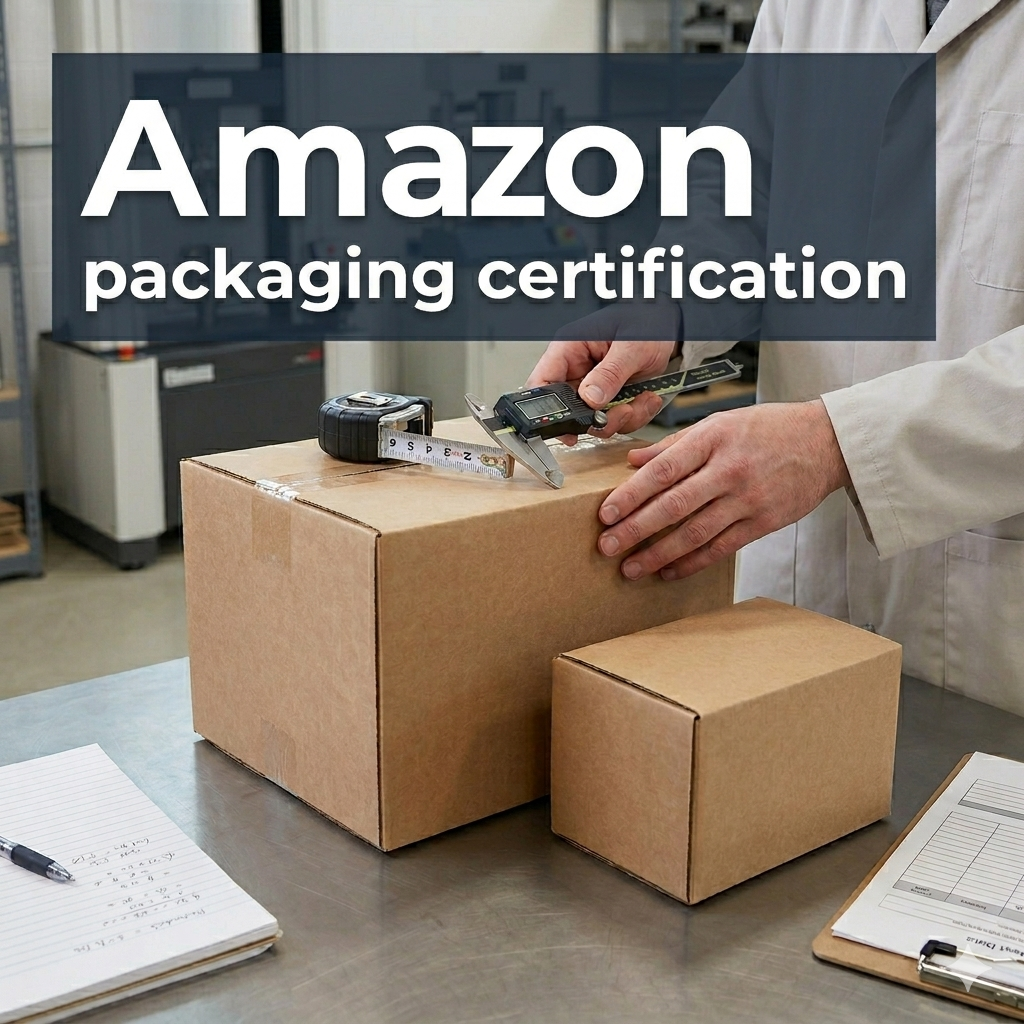
| What is Amazon packaging certification and which test do you need? Amazon packaging certification is tested under the ISTA 6-Amazon standard, which has two certification paths — SIOC and Over-Boxing. SIOC certifies products that ship in their existing retail or product packaging without additional boxing. Over-Boxing applies when a separate shipping carton surrounds the retail packaging. The correct path depends on how the product is listed, how it will be handled at the fulfillment center, and whether the retail packaging can withstand the parcel distribution environment without an outer carton. |
Amazon packaging certification is a required step before any product can be listed or fulfilled through FBA — and selecting the wrong certification path is one of the most common reasons launch timelines slip. The two paths under the ISTA 6-Amazon standard each have distinct test requirements, and a submission under the wrong one means starting over with a full retest cycle.
gh Testing runs two labs — our Ohio lab is ISO 17025 accredited; our Phoenix lab runs the same testing programs. The question we get most consistently from packaging engineers and Amazon sellers isn’t how to run the test — it’s which certification path actually applies to their product configuration.
Why Certification Path Selection Determines Your Timeline
Amazon’s FBA fulfillment process will not accept a product until packaging certification documentation is complete and submitted through the Vendor or Seller Central portal. That means the certification is on the critical path for any launch with a planned FBA date — not a parallel track that can run after go-live.
The three certification paths are not interchangeable. Each uses a different test sequence, different pass/fail criteria, and different documentation requirements. A product submitted under Over-Boxing when it actually qualifies for SIOC does not carry over — Amazon requires the correct path to be completed from the beginning.
Getting the path right before submitting samples to the lab eliminates the most common source of retest cycles in Amazon packaging programs. The test itself is straightforward once the path is confirmed. The path decision is where most programs lose time.
ISTA 6-Amazon and Its Two Certification Paths
ISTA 6-Amazon
ISTA 6-Amazon is the standard Amazon developed specifically for its fulfillment network — built to simulate the sortation, conveyor systems, drop events, and delivery vehicle vibration a product encounters moving through Amazon’s system. Every Amazon packaging certification falls under this one standard, tested one of two ways depending on how the product ships.
SIOC — Ships in Own Container
SIOC certification applies to products that ship in their existing retail or product packaging without any additional boxing. To qualify, the packaging must pass a performance test sequence — including drop, compression, and vibration — without an outer shipping carton. The test confirms that the retail package itself is sufficient to protect the product through the parcel distribution environment.
SIOC is a meaningful design achievement. Not all retail packaging is engineered to meet the thresholds required for the parcel environment without outer protection. tend to require fewer test cycles.
Over-Boxing
Over-boxing applies when a separate shipping carton is added around the retail packaging before the product enters the fulfillment network. The test sequence evaluates the combined package — shipping carton plus retail packaging plus product — through the same parcel distribution hazards.
Over-boxing is the most common path for products where the retail packaging alone does not meet SIOC performance thresholds. It is also the default path for many CPG and consumer electronics products where the retail package is designed for shelf presence rather than parcel durability.
How to Choose Between SIOC and Over-Boxing
The decision between SIOC and Over-boxing is not always obvious from the product specification. It depends on three factors: whether the retail packaging can structurally survive the parcel environment without an outer carton, how the product will be picked and packed at the fulfillment center, and how the product is listed in Amazon’s catalog.
Products that are dimensionally suitable for SIOC — typically rigid packaging, sturdy corrugated structures, or packaging with adequate edge crush and drop resistance — are worth evaluating for SIOC certification first. A failed SIOC attempt does not preclude Over-boxing, but it does add a test cycle and lead time to the program.
For products where the retail packaging is thin-walled, flexible, or designed primarily for shelf appeal, Over-boxing is almost always the more direct path. Running a quick structural assessment before selecting a certification path avoids the cost of a SIOC attempt on packaging that is not a viable candidate.
What Amazon Packaging Certification Testing Actually Involves
All three Amazon certification paths use test sequences developed under the ISTA framework and tailored to the Amazon fulfillment environment. The sequences include drop testing at specified heights and orientations, vibration profiles that simulate parcel carrier vehicle dynamics, and compression testing to account for stacking in transit and at the fulfillment center.
Atmospheric conditioning is required before testing begins. Samples are conditioned at controlled temperature and humidity per ISTA protocol — typically 24 to 48 hours — before the test sequence starts. This conditioning step reflects the real-world humidity exposure packaging encounters in fulfillment center environments and cannot be compressed regardless of schedule pressure.
Sample quantities vary by product category and packaging configuration. Programs with multiple SKUs, package sizes, or configurations require separate test sequences for each. Confirming sample requirements before shipping product to the lab avoids the most common source of scheduling delays on Amazon programs.
Three Things to Confirm Before Submitting for Amazon Testing
Most Amazon packaging certification programs that come to us with timeline pressure have the same gaps. Addressing these before submitting samples to the lab keeps the program on schedule.
- Confirm the certification path before ordering test samples. Path selection determines sample quantity, test sequence, and documentation format. Changing paths mid-process requires starting over. A short conversation with the lab before samples ship is worth the time.
- Confirm the ASIN and product listing configuration. Amazon’s certification requirements are tied to how the product is listed and how it will be fulfilled. Products with multiple ASINs or configurations may require separate certifications. Confirming listing details before testing begins ensures the documentation matches what Amazon’s portal requires.
- Account for conditioning lead time in the schedule. The 24 to 48 hours of atmospheric conditioning required before testing is a fixed, non-negotiable step. It needs to be treated as a separate block of time before the test sequence — not as part of the test duration itself. Understanding how conditioning time interacts with your full program schedule is covered in detail in our guide to packaging testing delays and their real cost.
Amazon packaging certification is a clearly defined process once the correct path is identified. The test sequences are specific, the documentation requirements are known, and the pass/fail criteria are set. What creates timeline problems is starting down the wrong path or arriving at the lab without the product configuration questions answered — both are among the most common sources of packaging testing delays.
gh Package and Product Testing runs e-commerce and Amazon testing programs under the ISTA 6-Amazon standard — both the SIOC and Over-Boxing paths.When you contact us, you get a direct conversation about which certification path fits your product configuration and your FBA timeline — not a quote form and a wait.
If you are not sure which Amazon certification path applies to your product, contact us and ask which test is right for your product.
ace with:
“What’s the difference between ISTA 6-Amazon SIOC and Over-Boxing certification?
Both fall under the ISTA 6-Amazon standard, Amazon’s certification requirement for products shipped through its fulfillment network. SIOC certifies products that ship in their own retail or product container without added boxing, confirming the existing packaging can survive the parcel environment on its own. Over-Boxing applies when a separate shipping carton is added around the retail package. Each path has its own test sequence and documentation requirements.
Does Amazon require packaging certification before a product can be listed on FBA?
Yes. Amazon requires completed packaging certification documentation before a product can be listed or fulfilled through FBA. The certification must be submitted through the Vendor or Seller Central portal and accepted before the listing is activated for fulfillment. Testing lead time — including conditioning — needs to be built into the launch schedule, not treated as a parallel track.
How long does Amazon packaging certification testing take?
Test lead time for Amazon packaging certification depends on the certification path, sample quantity, and lab scheduling. Atmospheric conditioning adds 24 to 48 hours before the test sequence begins — this step is mandated by ISTA protocol and cannot be shortened. Programs with multiple configurations or SKUs require separate test sequences for each. Planning for two to four weeks of total lead time is reasonable for a single-configuration program on a standard schedule.
Can a product fail SIOC certification and still be certified through Over-Boxing?
Yes. A failed SIOC attempt does not disqualify a product from Over-Boxing certification. The two paths are evaluated independently. A product that does not meet SIOC performance thresholds can be submitted under Over-Boxing with an appropriate shipping carton added. The Over-Boxing test sequence evaluates the combined package — shipping carton, retail packaging, and product — through the same parcel distribution hazards.