
| Why does extreme temperature testing matter more than standard conditioning profiles? Standard environmental conditioning tests a single, controlled temperature and humidity condition. Real shipments rarely experience that — they swing between cold warehouse docks, hot trailers spiking above 120°F, and rapid transitions in between, sometimes within the same day. Testing only the standard profile misses exactly the conditions most likely to reveal a packaging or adhesive failure. |
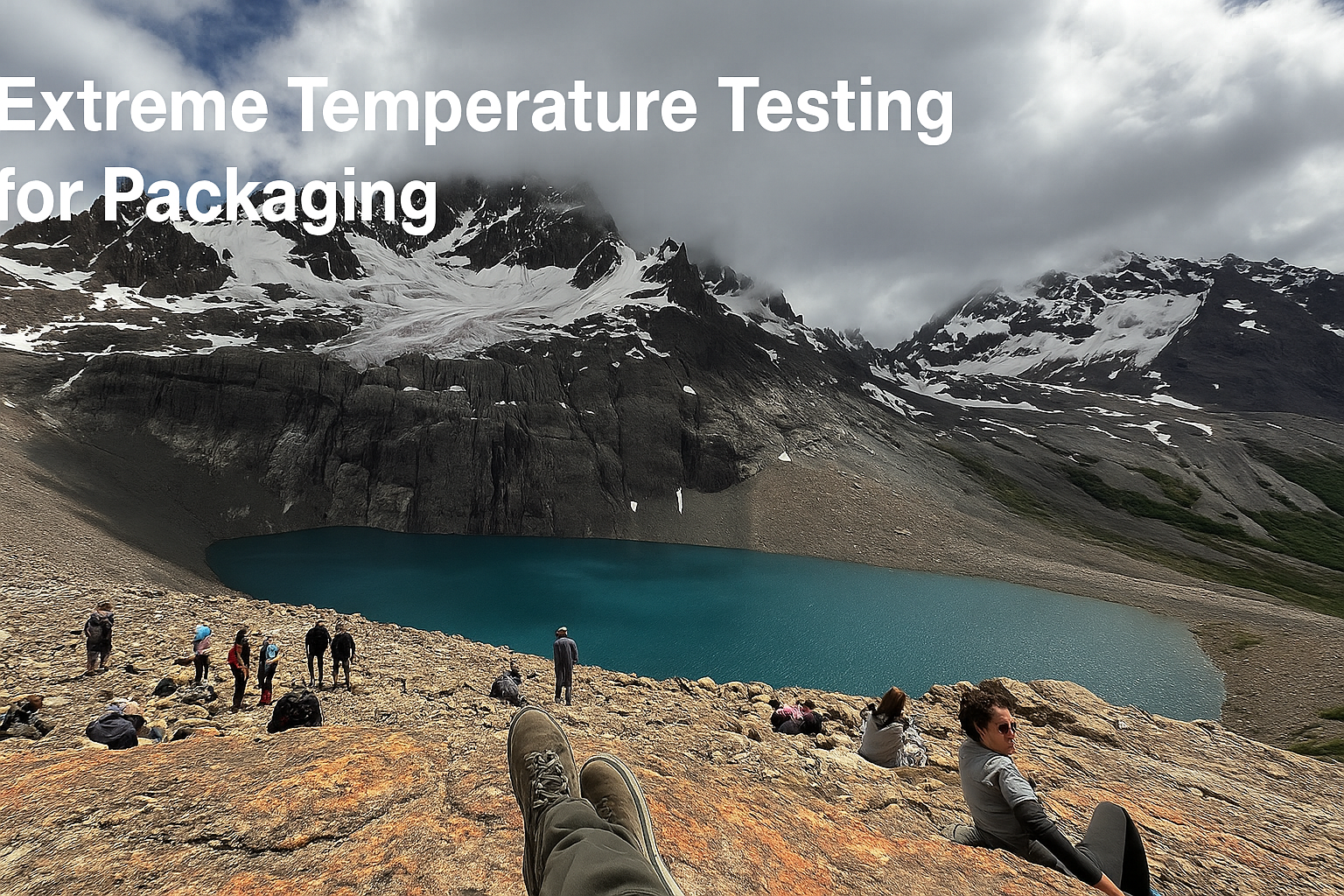
During a recent endurance trek through Patagonia, gh Testing’s President Perry felt temperature swings that changed within minutes — the morning started below freezing, and by afternoon the rocks were radiating heat as the wind shifted everything again. That experience stuck with him, and it’s a good illustration of something packaging teams routinely underestimate: real-world temperature exposure rarely moves in a gentle, linear line. It swings fast, unevenly, and sometimes severely.
At gh Testing, we see packaging teams rely on standard conditioning profiles without fully accounting for the actual environments their products travel through. Products can pass through cold warehouse docks, hot trailers that spike above 120°F, unheated tarmacs, mountain passes, climate-controlled facilities followed immediately by outside exposure, and multi-day routes with unpredictable dwell times. A profile built around one steady condition doesn’t catch what happens when a shipment moves through several of these in the same 24 hours.
Three Blind Spots We See Most Often
1. Temperature shifts along the real shipping route. Most packaging teams don’t have visibility into how often a shipment actually heats, cools, and cycles during transport — the standard conditioning profile is a reasonable baseline, but it isn’t the same as the route.
2. Material performance under real stress. Heat weakens adhesives. Cold cracks plastics. Corrugate absorbs moisture and loses strength. Insulating systems behave differently under rapid cycling than they do under one steady exposure — and these effects only show up when the test replicates the cycling itself, not a single static condition.
3. The gap between standards and reality. ISTA 7D and standard ASTM conditioning are genuinely useful baselines, but they rarely match the most extreme environments a specific product actually encounters on its specific route. Cold chain validation for pharmaceutical and medical device shipments is where this gap matters most — a distribution profile built too conservatively often only gets discovered once a field temperature excursion has already happened.
If your test program is built around one standard conditioning profile and your product actually moves through multiple climates or handling environments, that’s worth reviewing before your next shipment. Contact gh Testing to talk through what your actual route looks like.
How gh Testing Builds Realistic Temperature Profiles
Realistic temperature and humidity profiles — we design profiles based on how products actually travel, including dwell periods, rapid transitions, long delays, and seasonal variation. Summer heat exposure is one common version of this; extreme or rapidly cycling conditions are another.
Practical cold chain expertise — cold chain packaging doesn’t follow one strict standard. It depends on experience, data interpretation, and environmental simulation built around the actual product and route, whether that’s pharmaceuticals, food, or advanced materials.
A process built around communication, not just equipment — technical capability is only part of what makes testing useful. Clear communication, project planning, risk mapping, and guidance that simplifies the work on your end matters just as much as the chamber itself.
Frequently Asked Questions
Do I need extreme temperature testing if my product already passed standard ISTA or ASTM conditioning?
It depends on the actual route. Standard conditioning is a solid baseline, but if your product travels through multiple climate zones, experiences long dwell times, or moves through non-climate-controlled environments (a hot trailer, an unheated tarmac, a mountain pass), a standard profile may not reflect what the product actually experiences. Mapping the real route first tells you whether extended or custom profiles are worth adding.
What kinds of products benefit most from extreme temperature testing?
Anything with adhesives, seals, or temperature-sensitive materials moving through variable climates — pharmaceuticals, food and beverage, cosmetics, and electronics all commonly need it. Products moving through desert regions, high-altitude routes, or multi-day cross-country shipping are especially exposed to conditions a standard profile doesn’t capture.
How is an extreme temperature test different from standard environmental conditioning?
Standard conditioning typically tests one steady temperature and humidity condition for a set duration. Extreme temperature testing builds a profile around real, variable conditions — rapid cycling, dwell periods at different temperatures, and sequences that mirror an actual multi-leg shipment rather than one controlled exposure.
Ready to Strengthen Your Packaging for Real Conditions
Conditions like the ones Perry experienced in Patagonia aren’t unique to a mountain trek — similar extremes exist in the Yukon, Alaska, high-altitude cities, and desert shipping routes, and they affect how packaging performs under real stress.
If your product travels through heat, cold, altitude, or rapid temperature changes, tell us the route and we’ll tell you whether your current test profile actually covers it. Contact gh Testing or call 513-870-0080.