
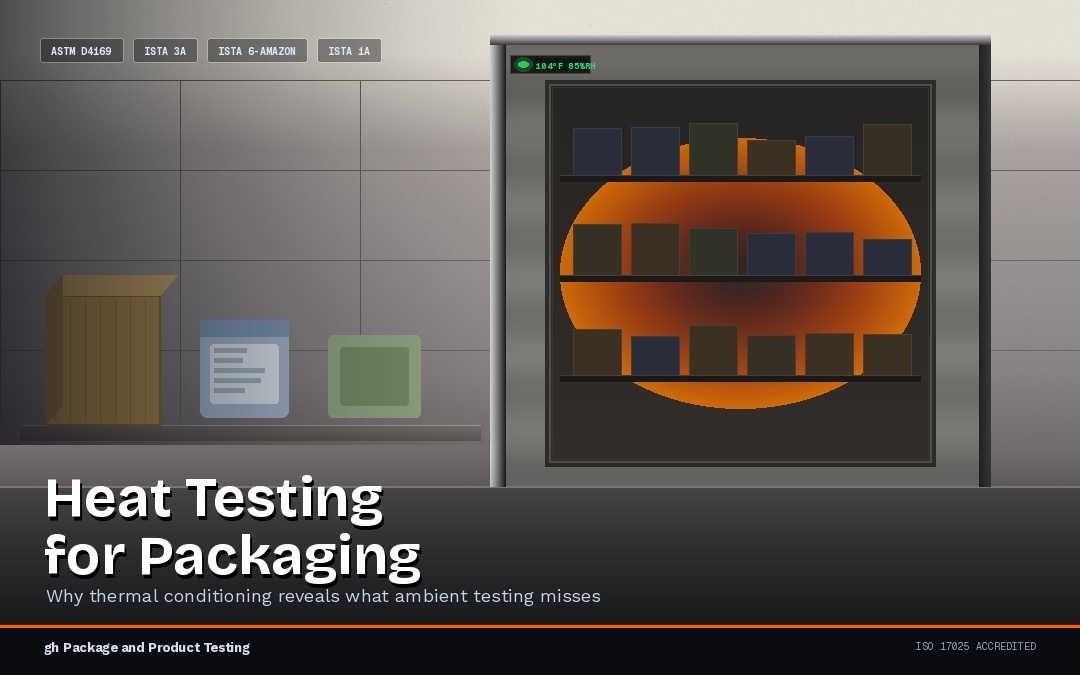
| What is heat testing for packaging and when do you need it? Heat testing for packaging involves conditioning samples at elevated temperature and humidity before running standard ISTA or ASTM mechanical test sequences. It replicates the thermal stress packaging encounters inside enclosed trailers, warehouse staging areas, and tarmac transfers during summer shipping. It is required any time a product ships through warm-climate distribution channels or contains adhesive closures, heat-sealed flexible components, or foam cushioning systems that change mechanical properties with temperature. Running ISTA 3A or ASTM D4169 at ambient conditions without thermal pre-conditioning produces a test record that reflects lab performance, not real summer supply chain conditions. |
Heat testing for packaging consistently surfaces failure modes that standard ambient testing misses entirely. By the time summer shipping season starts, corrugated board, adhesives, and heat-sealed closures have already been exposed to temperature extremes inside trailers, warehouse staging areas, and tarmac transfers. Waiting until field damage appears is not a testing strategy — it is a gap in validation.
How Elevated Temperature Degrades Packaging Structures
Corrugated board loses compression strength as humidity rises with heat. At conditions around 100°F and 85% relative humidity — conditions common inside enclosed trailers during summer months — box compression values can drop significantly compared to controlled lab measurements. ASTM D4169 and ISTA 3A testing performed only at ambient conditions will not capture that shift.
Adhesive bonds are equally vulnerable. Hot melt adhesives used in case sealing, tray forming, and label attachment soften at temperatures that are achievable inside parked trailers or during tarmac dwell time. When a compression or drop test follows thermal conditioning, failures at adhesive joints become visible that would never appear in a standard ambient sequence.
What Heat Testing for Packaging Actually Evaluates
gh testing runs environmental conditioning prior to mechanical testing sequences to replicate the cumulative stress of real distribution. This typically includes soak periods at elevated temperature and humidity using ASTM D4169 conditioning schedules, or pre-conditioning as specified under ISTA 1A, 3A, or 6-Amazon protocols before drop, vibration, and compression test sequences.
The conditioning parameters depend on the distribution channel. A product moving through Southwest United States ground routes — including transfers through Phoenix-area distribution hubs — faces different temperature exposure than the same product moving through Midwest warehouse networks. Both scenarios can be modeled and replicated in controlled chamber environments.
Testing at elevated temperature is not a separate test from mechanical testing. It is the conditioning step that makes mechanical testing reflect what actually happens in a summer supply chain.
Failure Modes That Only Appear After Thermal Conditioning
Seal integrity failures are among the most common findings after thermal conditioning in pharma and CPG packaging. Heat-sealed flexible packaging, lidding films, and blister components all have sealing window limits. Exposure to elevated temperature during storage or transit can weaken seal strength below functional thresholds even before a drop event occurs.
Foam cushioning systems — polyethylene, polyurethane, and molded pulp — also change mechanical properties with temperature. A foam that passes cushioning performance calculations at 72°F may bottom out or creep under static compression at 110°F. If the product relies on that foam for fragility protection, the thermal shift in cushioning behavior matters.
Corrugated outer shippers show stacking failure at elevated temperature and humidity well before visible structural damage appears. Palletized loads that hold through ambient vibration testing can shift or collapse after a 24-hour thermal soak that replicates warehouse staging in summer.
Why Amazon Shipments Need Heat Testing for Packaging Validation
ISTA 6-Amazon protocols are frequently run without thermal pre-conditioning, especially when teams are under schedule pressure. The result is a test that confirms ambient performance but does not address what happens to a small parcel shipment sitting on a porch in Phoenix in July, or inside a non-climate-controlled last-mile vehicle.
Amazon’s requirements do not prohibit additional conditioning. For product categories with adhesive closures, heat-sensitive labels, or flexible packaging seals, adding a thermal soak before the ISTA 6-Amazon mechanical sequence provides data that ambient-only testing cannot. That data either confirms the package is adequately designed or identifies specific failure points before commercial release.
If a product is being shipped through warm-climate distribution channels and the validation protocol does not include heat conditioning, the test record has a gap.
Selecting the Right Conditioning Parameters
Not every product needs extreme heat testing. The right conditioning profile depends on the distribution channel, the time of year commercial volumes will peak, and the thermal sensitivity of the product-package system.
ASTM D4169 Assurance Level II is a reasonable starting point for most standard commercial distribution. ISTA 3A conditioning schedules address parcel shipments through standard carrier networks. Products with known heat-sensitive components — pharmaceutical coatings, adhesive closures, foam suspension systems — may require custom conditioning profiles that exceed standard protocol parameters.
gh testing’s environmental chambers can hold temperatures and humidity levels that replicate worst-case seasonal conditions across multiple distribution environments, including the elevated ambient temperatures common to Southwest U.S. routing. Understanding which conditioning profile applies to a specific product and channel is where test planning adds value before a single sample is placed in a chamber.
Frequently Asked Questions
| Does ISTA 6-Amazon require thermal conditioning before testing? ISTA 6-Amazon protocols do not prohibit thermal conditioning, and Amazon’s requirements do not prevent it. For products with adhesive closures, heat-sensitive labels, or flexible packaging seals, adding a thermal soak before the ISTA 6-Amazon mechanical sequence provides data that ambient-only testing cannot. If a product ships through warm-climate channels or peaks in summer, thermal pre-conditioning before ISTA 6-Amazon testing closes a real validation gap. What temperature and humidity levels are used in heat testing for packaging? Conditioning parameters depend on the distribution channel and product type. ASTM D4169 conditioning schedules and ISTA protocol pre-conditioning options cover a range of profiles from controlled ambient conditions at 72 degrees F and 50% relative humidity up to hot and humid conditions at 100 degrees F and 85% relative humidity, and extreme heat profiles at 140 degrees F. Products moving through Southwest U.S. ground routes face different exposure than Midwest warehouse distribution. gh testing’s environmental chambers replicate all standard conditioning profiles as well as custom parameters for specific distribution environments. How does heat affect corrugated packaging compression strength? Corrugated board loses compression strength as relative humidity increases with temperature. At conditions around 100 degrees F and 85% relative humidity, box compression values can drop significantly compared to measurements taken at standard lab conditions of 72 degrees F and 50% relative humidity. A corrugated outer shipper that passes stacking tests under ambient conditions may fail under the same load after a thermal soak that replicates summer warehouse staging. Testing compression after thermal conditioning rather than at ambient conditions produces a more accurate picture of real-world performance. What packaging components are most vulnerable to heat exposure during distribution? Four components show the most consistent failure patterns after thermal conditioning. Hot melt adhesives used in case sealing and tray forming soften at temperatures achievable inside parked trailers. Heat-sealed flexible packaging and lidding films can lose seal strength below functional thresholds from thermal exposure alone before any mechanical test begins. Foam cushioning systems including polyethylene and polyurethane change mechanical properties at elevated temperature, reducing fragility protection. Corrugated outer shippers show compression and stacking failure under humid heat conditions well before visible structural damage appears. |
If you are not sure which conditioning parameters apply to your product and distribution channel, ask which test is right for your product before finalizing your validation plan.
What Heat Testing for Packaging Tells You Before You Ship
Heat testing for packaging is not a seasonal concern — it is a year-round validation requirement for any product that will ship through warm-climate channels or peak in summer. Adhesive failures, seal degradation, cushioning performance shifts, and board compression losses are all predictable under thermal conditioning. They are also preventable when identified before commercial release.
Running ISTA or ASTM mechanical tests without appropriate thermal conditioning produces a test record that reflects lab conditions, not real supply chain conditions. For pharma, CPG, and e-commerce sellers, that gap carries real cost when field damage begins appearing in July.
Learn more about environmental chamber testing at gh Testing to understand how thermal conditioning integrates with full distribution test sequences.
For additional reference on environmental conditioning standards, ISTA publishes test procedure documentation at ista.org.